
Farah Zahir
Editor, Oniket Research Group
The purpose of this article is to examine why Bangladesh continues to remain largely absent from the global beauty pageant, modelling, and celebrity brand ambassador industries despite possessing one of the world’s largest garment manufacturing sectors. It argues that the country’s limited international presence is not the result of a shortage of talent but of institutional, policy, and cultural shortcomings that have prevented the development of a competitive creative industry.
The article finds that Bangladesh has experienced decades of interrupted participation in international pageants, weak investment in professional talent development, and persistent social resistance toward careers in modelling and entertainment. Unlike neighbouring countries such as India and Sri Lanka, Bangladesh has not developed stable institutions capable of transforming individual talent into long term cultural and commercial success.
The article recommends that Bangladesh adopt a national creative economy strategy that recognises modelling, fashion promotion, talent management, and international cultural representation as legitimate economic sectors. Stable institutions, professional training, stronger legal protections, and broader public engagement would allow the country to convert its manufacturing strength into greater cultural influence and commercial opportunity.
A Large Fashion Industry with Limited Global Representation
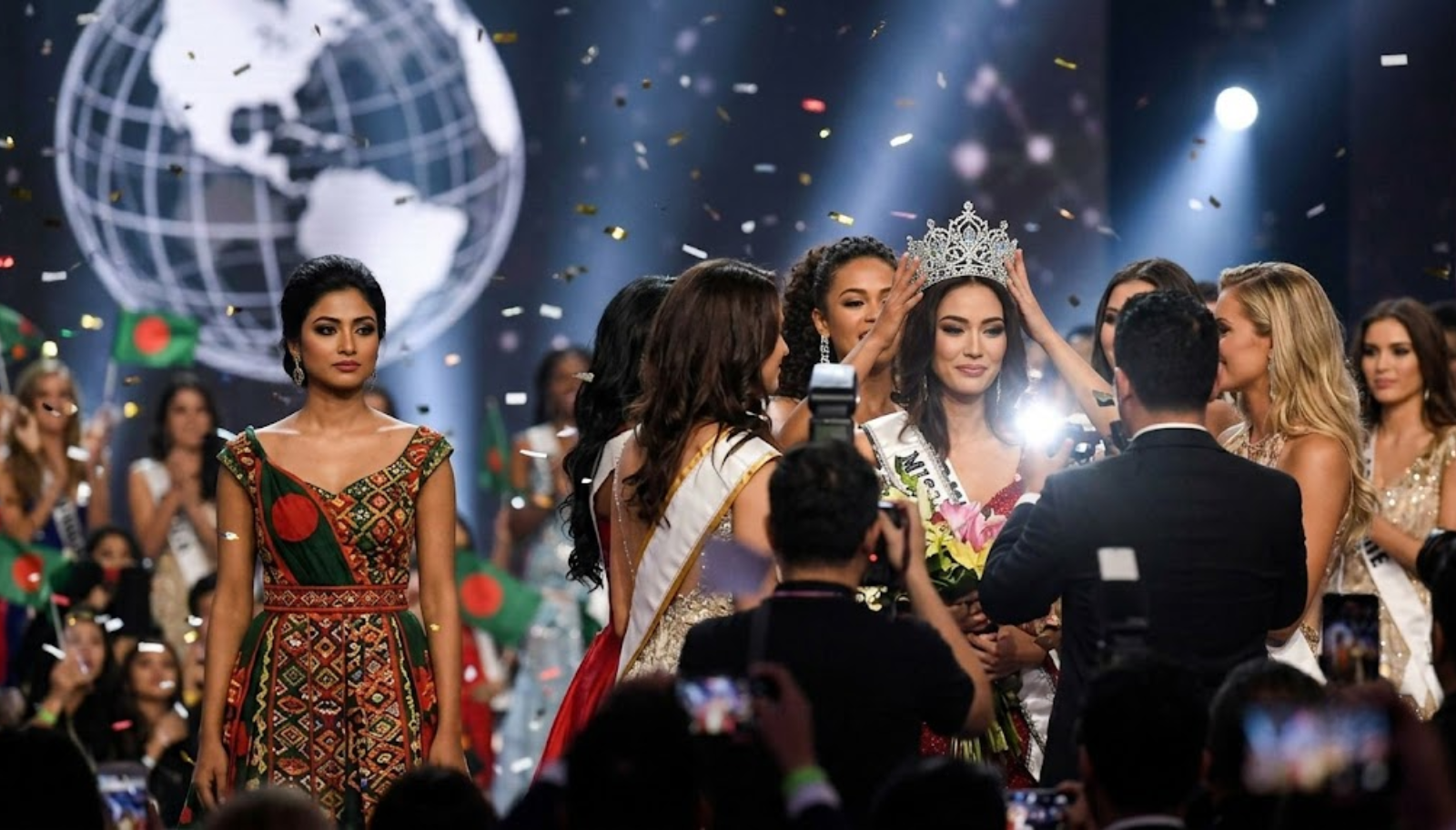
For a country of nearly one hundred seventy million people and one of the world’s leading garment exporters, Bangladesh has a surprisingly limited presence in international beauty pageants, modelling, and celebrity brand endorsements. India has produced six Miss World winners and three Miss Universe titleholders since the 1960s, while Sri Lanka, despite its much smaller population, has maintained uninterrupted participation in Miss World since 1953 and continues to achieve respectable international results. Bangladesh only entered Miss Universe for the first time in 2020, and its highest placement, a Top 30 finish in 2025, remains its strongest achievement.
The difference cannot be explained simply by population size, physical appearance, or individual ability. Instead, it reflects the absence of long-term institutional planning and a national policy that recognises the commercial value of the creative industries.
From Early Participation to Institutional Discontinuity
Bangladesh first participated in Miss World in 1994, during the same period that India emerged as a global pageant powerhouse through the international victories of Aishwarya Rai and Sushmita Sen. However, national pageant activities came to an abrupt halt after 2001 when religious opposition intensified and organisers withdrew rather than continue amid public controversy. Participation in the world’s leading pageants remained suspended for approximately sixteen years before Miss World Bangladesh was revived, while Miss Universe Bangladesh was introduced only in 2020.
The interruption created an institutional vacuum. Successful pageant countries rely on organisations that operate consistently over decades, allowing contestants to benefit from accumulated experience in coaching, public speaking, media training, and international networking. India’s Femina Miss India and Sri Lanka’s ModelShop have become permanent talent development institutions rather than occasional events. Bangladesh has not built comparable continuity.
The Missing Policy Framework
The policy gap is equally significant. Bangladesh has adopted policies supporting garment exports, tourism, and digital innovation, but it has never developed a national framework for the creative economy that includes modelling, fashion promotion, talent management, or international cultural representation. As a result, the country exports billions of dollars’ worth of clothing while capturing very little of the global value generated through fashion branding, celebrity endorsements, and cultural influence.
International pageants are frequently dismissed as entertainment, but they function as entry points into much larger economic industries. Contestants often become actors, television presenters, entrepreneurs, and international ambassadors for cosmetics, jewellery, fashion, tourism, and consumer brands. Their visibility contributes to national branding while generating commercial opportunities for domestic businesses.
Bangladesh possesses many of the foundations needed to participate more effectively. Its garment industry has earned global recognition for manufacturing, while an emerging community of designers, photographers, stylists, and media professionals continues to expand. What remains missing is the professional ecosystem that connects production with international visibility through talent agencies, management companies, media training, and strategic branding.
Social Attitudes and the Cost of Lost Opportunities
The social environment also continues to discourage participation. Bangladeshi contestants have frequently faced criticism for representing the country in international competitions, particularly when global pageant requirements conflict with conservative domestic expectations. Such reactions discourage talented young women from pursuing international careers and limit public acceptance of modelling and entertainment as legitimate professions. Similar attitudes have also restricted opportunities for male models and performers, preventing the emergence of a broader brand ambassador culture comparable to that found in neighbouring countries.
This is not solely a cultural issue. It is also a question of economic policy. Countries increasingly compete through culture, entertainment, and consumer brands alongside traditional exports. International recognition strengthens tourism, investment, and national reputation. Bangladesh has invested heavily in manufacturing capacity but comparatively little in developing the people who can represent those industries on the global stage.
Building a Competitive Creative Economy
Addressing this challenge requires sustained institutional commitment rather than occasional pageants. Bangladesh should incorporate fashion, modelling, talent management, and cultural representation into its national creative economy strategy. Professional pageant organisations should operate independently with transparent governance and predictable long-term support instead of depending on changing political or social circumstances.
Investment in talent development is equally important. Public and private partnerships can establish professional academies offering grooming, communication, styling, digital media, language training, and international etiquette. Stronger legal protections should also ensure that participants, organisers, and sponsors can operate without intimidation or arbitrary disruption.
Media organisations have an important responsibility as well. Coverage should recognise international representation as a professional achievement rather than reduce it to controversy. Public discussion involving educators, cultural leaders, industry representatives, and community organisations can also encourage a more balanced understanding of careers in modelling and entertainment within Bangladesh’s own cultural context.
Finally, Bangladesh’s fashion and beauty industries should embrace the country’s own diversity instead of pursuing imported standards of appearance. A broader representation of regional identities, skin tones, and body types would create a more authentic national image while strengthening international distinctiveness.
Bangladesh already possesses the population, creative talent, manufacturing capacity, and entrepreneurial potential to compete successfully in this field. The remaining challenge is to develop the policy framework, institutional continuity, and cultural confidence that transform individual success into sustained national influence.