
Assessing Structural Exposure and the Path to Energy Resilience
Iftekhar Rahman
Verdant Global
This article assesses the economic effects of QatarEnergy’s LNG disruption and identifies priorities for strengthening Bangladesh’s energy resilience.
The crisis exposes excessive dependence on imported LNG and the cost of underutilised generation without secure fuel. Immediate priorities are transparent procurement and disciplined gas allocation. Medium-term resilience requires diversified supply and domestic exploration, while long-term security depends on stronger governance, renewable energy and efficiency.
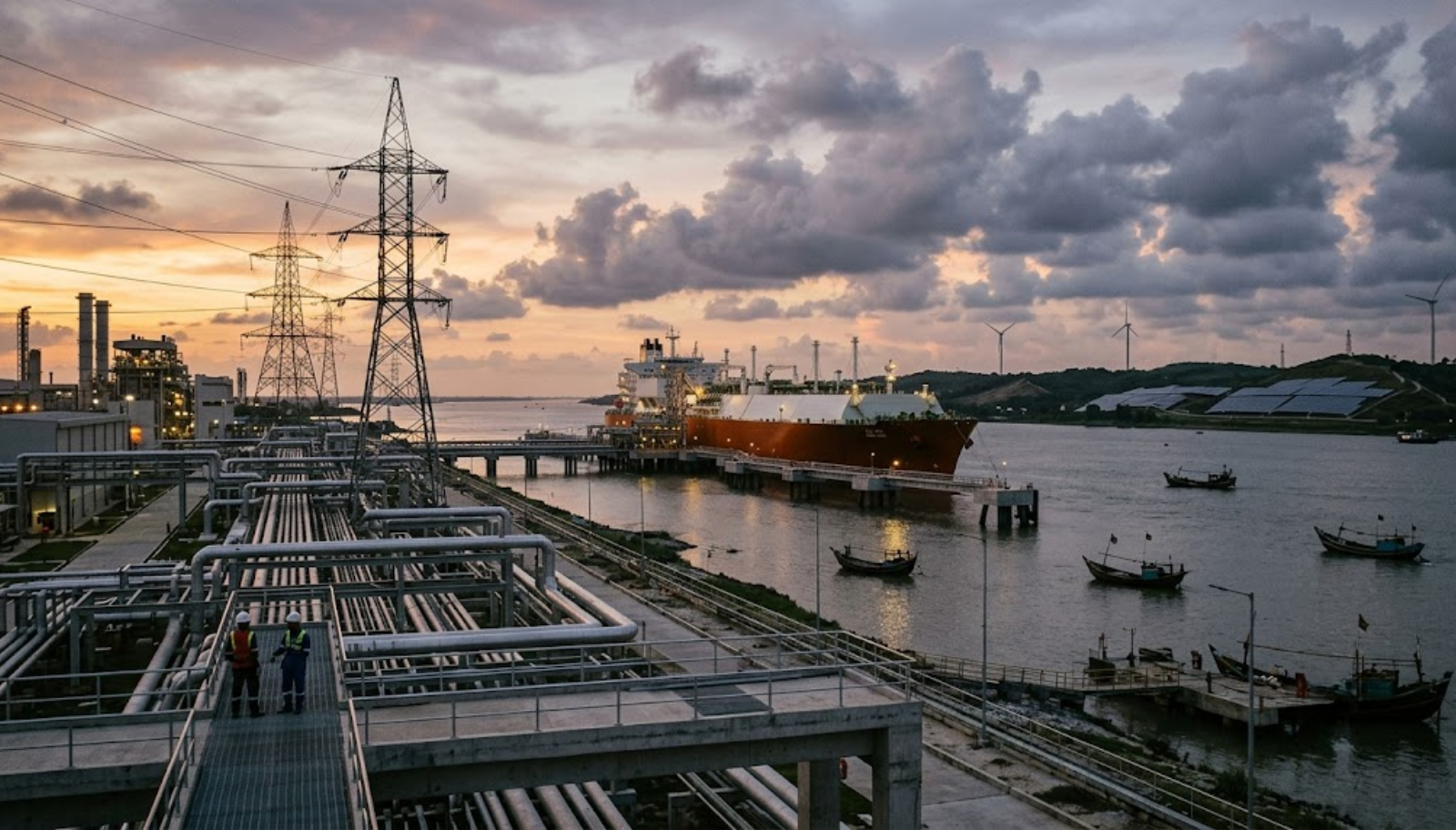
The disruption to QatarEnergy’s liquefied natural gas supply is no longer only an external procurement problem. It is transmitting through Bangladesh’s industry, public finances, agriculture and household welfare. Spot purchases may be unavoidable, but they cannot substitute for a coherent energy-security strategy.
From supply interruption to structural constraint
Qatar is Bangladesh’s largest LNG supplier. In 2025, nearly 4.3 million tonnes of Bangladesh’s approximately seven million tonnes of LNG imports were covered by two long-term Qatari contracts. One supplies around 2.5 million tonnes annually, while a second 15-year arrangement was intended to add approximately 1.8 million tonnes a year from 2026.12
Following the escalation of regional conflict, QatarEnergy declared force majeure. Subsequent attacks reportedly damaged two production trains at Ras Laffan, removing approximately 17% of Qatar’s export capacity. QatarEnergy indicated that restoration could take three to five years.3 Unlike a temporary shipping interruption through the Strait of Hormuz, damage to liquefaction facilities represents a potentially longer-term capacity constraint.
Petrobangla expects Bangladesh’s scheduled Qatari deliveries in 2026 to fall by approximately half. QatarEnergy has purchased US cargoes for Asian customers, including Bangladesh, but these volumes cannot fully replace disrupted production.4 The issue is therefore not whether Qatar remains a valued supplier, but whether national energy security should remain concentrated in one source, production hub and shipping route.
Industrial, fiscal and food-security exposure
Imported LNG supports electricity generation and gas-dependent industries including textiles, garments, ceramics, steel and fertiliser. Replacement cargoes purchased in March reportedly cost as much as US$28.28 per MMBtu, compared with approximately US$10 in January.5 Low gas pressure and load shedding also reduce machinery utilisation, disrupt production schedules and raise unit costs.
Merchandise exports fell by approximately 18% year on year to US$3.48 billion in March 2026, while garment exports declined by more than 19%.6 Energy shortages were not the sole cause, but persistent unreliability weakens Bangladesh’s competitiveness and could encourage international buyers to diversify future orders.
The disruption is also a fiscal and foreign-exchange shock. IEEFA estimates that LNG subsidies could reach approximately US$1.07 billion during the April to June 2026 quarter. Imported primary energy increased from 47.7% of national supply in FY2020–21 to 62.5% in FY2024–25.7 Taka depreciation further increases the cost of dollar-denominated fuel and power-sector obligations.
Bangladesh simultaneously maintains a reserve margin of approximately 61.3% and experiences electricity shortages.7 This reflects the difference between installed capacity and generation that is affordable, fuel-secured and available. The country is effectively paying for both scarcity and surplus. External financing can provide short-term liquidity, but borrowing for recurrent fuel imports does not correct this structural inefficiency.8
Agriculture is also exposed. Five of Bangladesh’s six major urea factories were reportedly shut in March after gas was redirected to other uses.9 Bangladesh therefore bears the cost of idle plants while spending foreign currency on imported fertiliser. Because fertiliser affects yields, food prices and rural incomes, production should be treated as part of national food-security infrastructure.
A three-horizon response
Immediate stabilisation
Immediate stabilisation should prioritise essential power, export industries and fertiliser production. Spot procurement must be competitive, transparent and centrally coordinated. Where rationing is unavoidable, predictable schedules would help factories manage operations. Bangladesh should also broaden discussions with suppliers across several regions, avoiding the replacement of one dominant source with another.
Medium-term diversification
Over the medium term, future LNG contracts should be evaluated not only on price, but also on destination flexibility, force-majeure protection, shipping exposure and the supplier’s ability to arrange replacement cargoes. Regular stress testing should be incorporated into contract approval.
Domestic exploration must return to the centre of policy. Offshore Bidding Round 2026 offers 26 Bay of Bengal blocks under revised production-sharing terms.10 Exploration will not solve the present shortage, but continued delay would deepen import dependence. Success will require credible geological data, contractual stability, transparent approvals and commercially viable pricing.
Long-term system reform
Long-term reform should reduce the extent to which economic growth depends on imported fossil fuels. Additional LNG infrastructure, including Matarbari, should proceed only after rigorous affordability, demand and environmental assessment. Import flexibility is valuable, but new terminals may also create long-term dollar obligations.
Renewable energy offers the clearest domestic hedge against fuel-price volatility. Bangladesh has approximately 1,559 MW of renewable capacity, including around 1,265 MW of solar.11 The tender for 495 MW of grid-connected solar is positive, but expansion requires bankable power-purchase agreements, reliable grid connections and competitive finance.12 Industrial rooftop solar and stronger efficiency standards could reduce daytime gas demand more rapidly than many large infrastructure projects.
A governance test
The QatarEnergy disruption is ultimately a governance test. Success should be measured not only by replacement cargoes, but by transparent procurement, disclosed subsidies, scrutiny of capacity payments, clear institutional accountability and coordination across energy, industrial, agricultural and fiscal policy.
Gas will remain important, but it should be one element of a diversified system rather than the default response to declining domestic production and slow renewable deployment. If Bangladesh uses this crisis to diversify supply, revive exploration, improve efficiency and strengthen governance, it can build a more resilient economic foundation.
Energy security is not measured by installed megawatts or signed contracts. It is measured by whether households, farms and industries receive reliable energy at a price the economy can sustainably afford.
References
1. Ruma Paul and Emily Chow, ‘QatarEnergy halves 2026 scheduled deliveries of LNG to Bangladesh, Petrobangla says’, Reuters, 6 July 2026, available at https://www.reuters.com/business/energy/qatarenergy-halves-2026-scheduled-deliveries-lng-bangladesh-says-petrobangla-2026-07-06/.
2. QatarEnergy, Annual Review 2023 (Doha, 2024), p. 33, available at https://www.qatarenergy.qa/en/MediaCenter/Publications/QatarEnergy%20Annual%20Review%202023.pdf.
3. ‘Iran attacks wipe out 17% of Qatar’s LNG capacity for up to five years, QatarEnergy CEO says’, Reuters, 19 March 2026, available at https://www.reuters.com/business/energy/iran-attack-damage-wipes-out-17-qatars-lng-capacity-three-five-years-qatarenergy-2026-03-19/.
4. Marwa Rashad, Emily Chow and Stephanie Kelly, ‘QatarEnergy buys 33 US LNG cargoes to offset Hormuz disruption, sources say’, Reuters, 30 July 2026, available at https://www.reuters.com/business/energy/qatarenergy-buys-33-us-lng-cargoes-offset-hormuz-disruption-sources-say-2026-07-30/.
5. ‘Bangladesh faces steep rise in LNG prices after Qatar supply halt’, Reuters, 6 March 2026, available at https://www.reuters.com/business/energy/bangladesh-faces-steep-rise-lng-prices-after-qatar-supply-halt-2026-03-06/.
6. Star Business Report, ‘Bangladesh’s exports fall for eighth consecutive month’, The Daily Star, 2 April 2026, available at https://www.thedailystar.net/business/news/bangladeshs-exports-fall-eighth-consecutive-month-4141921.
7. Shafiqul Alam, Fostering Bangladesh’s Energy Transition, Institute for Energy Economics and Financial Analysis, 6 May 2026, available at https://ieefa.org/resources/fostering-bangladeshs-energy-transition.
8. Ruma Paul, ‘Bangladesh eyes more than US$2 billion in fresh funds to mitigate fuel, LNG crisis’, Reuters, 20 March 2026, available at https://www.reuters.com/business/energy/bangladesh-eyes-more-than-2-billion-fresh-funds-mitigate-fuel-lng-crisis-2026-03-20/.
9. Mohammad Suman, ‘Gas crisis shuts down five of six major urea fertiliser plants’, The Daily Star, 5 March 2026, available at https://www.thedailystar.net/environment/natural-resources/energy/news/gas-crisis-shuts-down-5-6-major-urea-fertiliser-plants-4121571.
10. Ruma Paul, ‘Bangladesh offers sweetened terms in offshore tender to tackle energy crunch’, Reuters, 24 May 2026, available at https://www.reuters.com/business/energy/bangladesh-offers-sweetened-terms-offshore-tender-tackle-energy-crunch-2026-05-24/.
11. Bangladesh Investment Development Authority, ‘Renewable Energy Investment’, 2026, available at https://bida.gov.bd/investment-sector/renewable-energy.
12. Ruma Paul, ‘Bangladesh turns to solar as Middle East crisis drives energy risks’, Reuters, 6 May 2026, available at https://www.reuters.com/business/energy/bangladesh-turns-solar-middle-east-crisis-drives-energy-risks-2026-05-06/.