
Minhaz-Us-Salakeen Fahme
Game XR and SaaS Entrepreneur
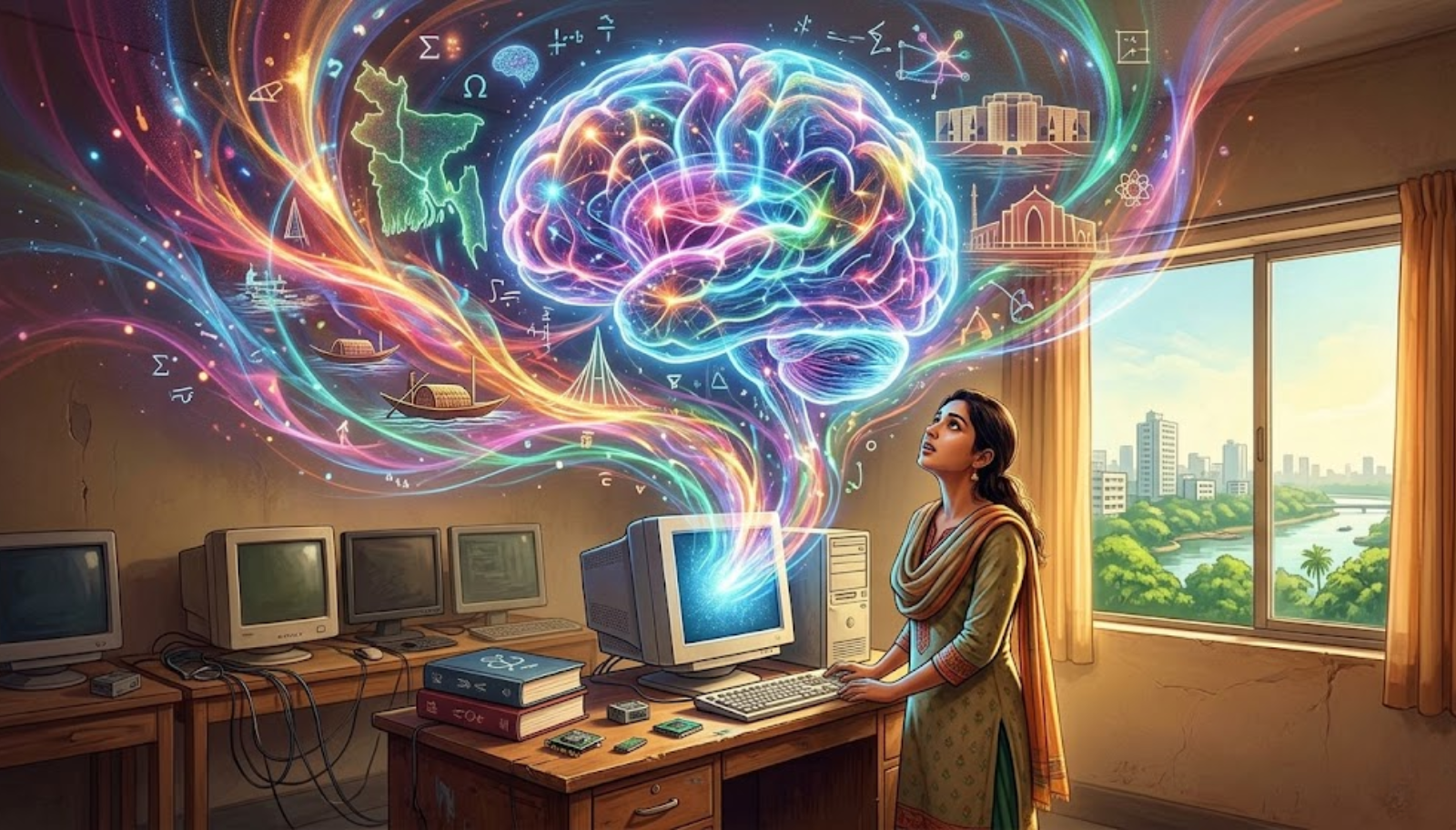
My first machines could barely hold the worlds I asked of them. Hercules on a wheezing family PC. Road Rash. DX-Ball 2. Space Impact on a Nokia with a screen smaller than a matchbox. Nobody told us those were limitations; we played like they were portals. We have always been people who dream bigger than our hardware.
Bangladesh’s AI ambition reads the same way. On paper, the dream is enormous: a National Strategy for Artificial Intelligence built on six pillars, a National AI Policy for 2026-2030 in final review, a commitment to accelerate one thousand AI startups in five years, a proposed national AI research centre with regional facilities embedded in universities. We rank 82nd on the Oxford Insights AI Readiness Index, but we carry over 650,000 IT professionals, a young digital workforce, and a startup ecosystem that barely existed a decade ago. The raw ingredients are here.
But ask the harder questions. How many Bangladeshi papers reached a top-tier AI conference in the past decade? A handful. How many laboratory discoveries became deployed products? Almost none. BUET’s pioneering AI lab has produced graduates building healthcare tools and Bangla language systems, and then what? Where do they train their models? On free-tier cloud services, queuing for borrowed GPU time, because no university here owns the compute that serious research demands.
Nokia all over again. Except this time the limitation is not charming, it is structural. And the stakes are no longer a high score. Agriculture employs nearly half our workforce; machine learning could predict planting windows and reducing crop disease from satellite imagery. Our doctor-to-patient ratio is among the lowest in South Asia; diagnostic AI could read chest X-rays and screen for diabetic retinopathy in overcrowded rural clinics. We are a delta nation staring down intensifying floods; we need predictive models far better than what we have. Forty per cent of our primary-aged children struggle to learn; adaptive tutoring in Bangla could change their lives.
Bangla itself may be the most personal gap of all. I write fiction in my mother tongue, and I have watched the world’s most powerful language models stumble over it. Without high-quality, publicly accessible Bangla corpora, every downstream dream, legal document analysis, a village chatbot for government services, stays locked behind a language the machines never properly learned. So, what stands in the way? Money flows to e-commerce and fintech because the returns come fast; deep-tech AI starves. There are almost no demo days or accelerators connecting AI founders to mentors and capital. No legal framework yet governs AI liability, training data privacy, or algorithmic accountability. And looming over all of it is the temptation to chase generative AI hype, to count chatbots and call it progress.
That is the wrong scoreboard. The future of AI research in Bangladesh will be measured by whether a farmer in Rangpur receives a flood warning from a model trained on local data, and whether a mother in Bandarban gets an accurate diagnosis in her own language. In 2015, when I co-founded a game studio here, there was no industry to join, so we built one. I have seen, firsthand, what this country does when it stops waiting for permission. AI research needs that same stubbornness now, plus something rarer: institutional patience for research that may take a decade to yield its first patent, and a century to repay it.
We dreamed bigger than the hardware once, on small screens with borrowed time. The hardware eventually caught up. It always does. The question is whether the dream survives the wait.