
Ziaul Hossain
Bangladesh Agricultural University
Bangladesh is one of the world’s most climate-vulnerable countries. Situated in the delta of the Ganges, Brahmaputra, and Meghna rivers and bordering the Bay of Bengal, the country experiences frequent cyclones, floods, heavy rainfall, heatwaves, and thunderstorms. Accurate weather forecasting is therefore not merely a scientific necessity but a matter of public safety, economic stability, and national resilience. While the Bangladesh Meteorological Department (BMD) has made considerable progress over the past decades, significant technological and institutional challenges continue to limit its forecasting capabilities.
One of the primary challenges is the shortage of modern observation infrastructure. Weather forecasting depends on real-time atmospheric data collected from weather stations, radars, satellites, ocean buoys, and upper-air observations. Although Bangladesh has expanded its network of automatic weather stations and Doppler weather radars, coverage remains uneven. Several coastal and remote regions still lack dense observation networks, reducing the accuracy of localized weather predictions. Aging instruments and maintenance delays further affect the quality of meteorological data.
Another major limitation is the insufficient use of advanced numerical weather prediction (NWP) models. Modern forecasting agencies worldwide rely on high-performance computing to run sophisticated atmospheric models capable of predicting weather patterns with increasing precision. Bangladesh still depends heavily on international forecasting products and regional models due to limited domestic supercomputing capacity. As a result, forecasts for rapidly developing weather events, such as severe thunderstorms, localized flash floods, and urban heavy rainfall, often lack the desired spatial and temporal accuracy.
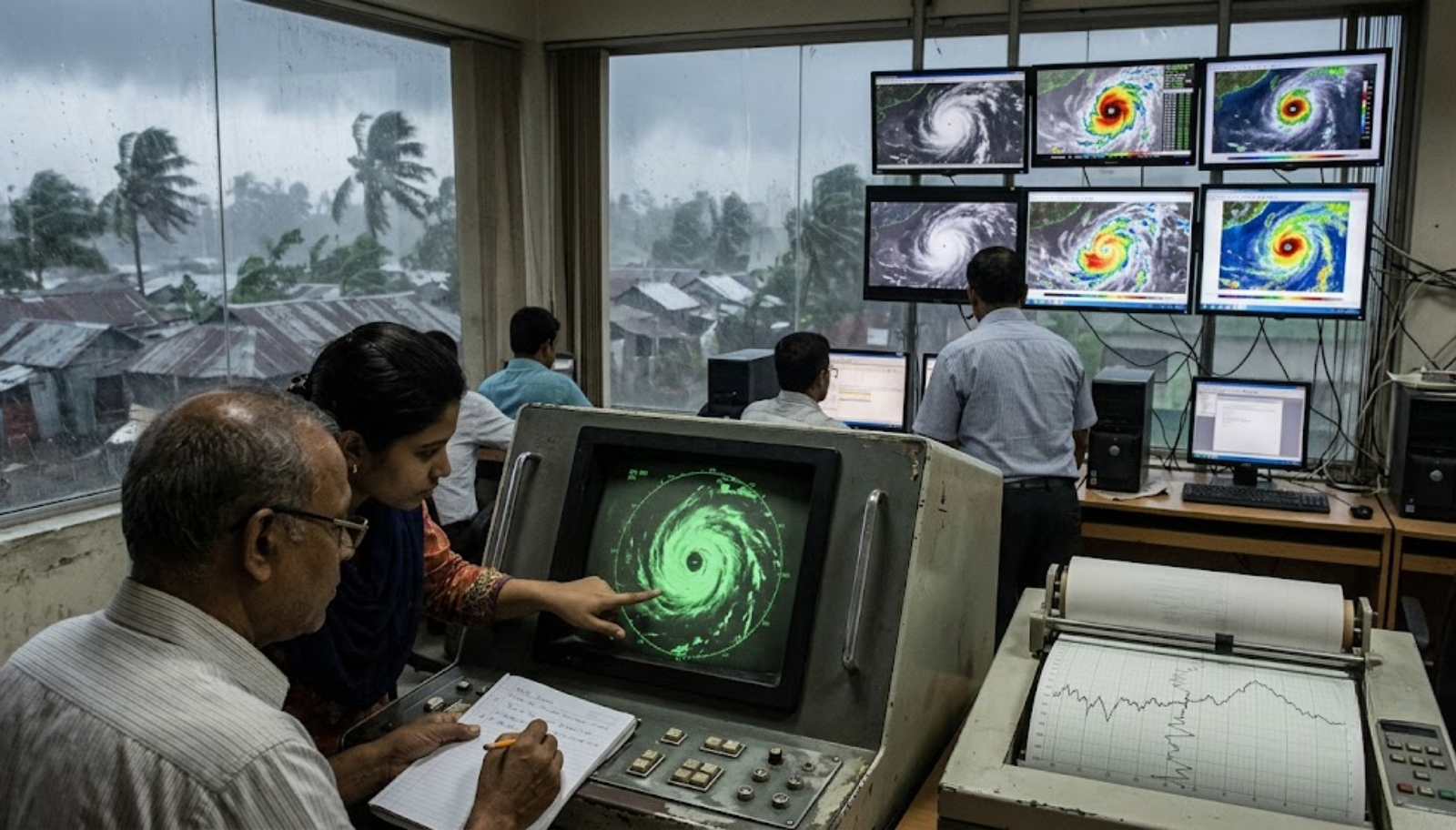
Cyclone forecasting has improved significantly over the past two decades, helping reduce cyclone-related fatalities. However, predicting cyclone intensity, storm surge height, and landfall location remains a complex challenge. Small errors in cyclone track prediction can significantly affect evacuation planning. Better integration of oceanographic observations, satellite imagery, and high-resolution coastal models is essential to improve early warning systems for coastal communities.
Flood forecasting also requires stronger coordination between meteorological and hydrological agencies. Bangladesh experiences river floods, flash floods, and urban flooding, each requiring different forecasting approaches. While rainfall forecasts have improved, translating precipitation forecasts into accurate flood predictions requires real-time river flow measurements, reservoir data, and integrated hydrological models. Enhanced data sharing among the Bangladesh Meteorological Department, the Bangladesh Water Development Board, and disaster management agencies would improve flood forecasting and emergency response.
Heatwaves have become increasingly frequent and severe due to climate change. However, heat forecasting remains relatively underdeveloped compared to cyclone warnings. Forecasts should include heat indices that combine temperature and humidity, allowing authorities to assess health risks more accurately. Early warning systems for extreme heat should be linked with public health agencies, schools, and labor-intensive industries to reduce heat-related illnesses and fatalities.
One technological gap is the limited application of artificial intelligence (AI) and machine learning in weather prediction. Many advanced meteorological agencies now use AI to enhance radar interpretation, improve rainfall estimation, detect severe storms, and refine short-term forecasts. AI can also analyze decades of historical climate data to identify emerging weather patterns and improve forecast accuracy. Bangladesh has significant opportunities to adopt these technologies through collaboration with universities, research institutions, and international meteorological organizations.
Human resource development represents another important challenge. Modern meteorology requires expertise in atmospheric science, computer science, remote sensing, data analytics, and artificial intelligence. Continuous professional training, international collaboration, and research partnerships are necessary to build a highly skilled workforce capable of operating advanced forecasting systems and interpreting increasingly complex climate data.
Communication of weather forecasts also needs improvement. Forecasts should be timely, location-specific, and easy for the public to understand. Mobile applications, SMS alerts, social media platforms, community radio, and television should all be integrated into a unified early warning system. Forecasts should clearly communicate the level of risk, expected impacts, and recommended protective actions rather than relying solely on technical meteorological terminology. Special attention should be given to vulnerable populations, including fishermen, farmers, coastal residents, and urban informal settlements.
Investment in weather radar modernization is another critical priority. High-resolution Doppler weather radars can detect severe thunderstorms, hail, tornadoes, and intense rainfall several hours before they occur. Expanding radar coverage and ensuring continuous maintenance would substantially improve short-term forecasting, particularly during the monsoon season when localized heavy rainfall frequently causes urban flooding.
Climate change further complicates forecasting by increasing the frequency and intensity of extreme weather events. Traditional forecasting methods based solely on historical climate patterns are becoming less reliable. Continuous research into changing climate behavior, coupled with improved climate modeling, is necessary to adapt forecasting systems to evolving environmental conditions.
Looking ahead, Bangladesh should prioritize investments in supercomputing facilities, expanded observation networks, modern weather satellites, advanced radar systems, AI-based forecasting tools, and integrated meteorological-hydrological modeling. Strengthening international cooperation with organizations such as the World Meteorological Organization and leading weather agencies can accelerate technology transfer and capacity building. Public-private partnerships can also support innovation in weather services and digital communication platforms.
In conclusion, Bangladesh has made remarkable progress in weather forecasting and disaster preparedness, particularly in reducing cyclone-related deaths. Nevertheless, growing climate risks demand a new generation of technological modernization. By investing in advanced forecasting technologies, strengthening scientific expertise, improving institutional coordination, and enhancing public communication, the Bangladesh Meteorological Department can provide more accurate and timely predictions of cyclones, rainfall, heatwaves, and floods. Such reforms will not only protect lives and property but also strengthen national resilience in the face of an increasingly uncertain climate future.