
Ruksana Akhter
Freelance Architect
Dhaka’s traffic congestion is more than an inconvenience; it poses a significant business challenge. This is a structural drag on Bangladesh’s economic productivity. The combination of rapid urbanization, rising vehicle ownership, and chronically insufficient road capacity has led to long and unpredictable commutes, which negatively impact quality of life and business efficiency.
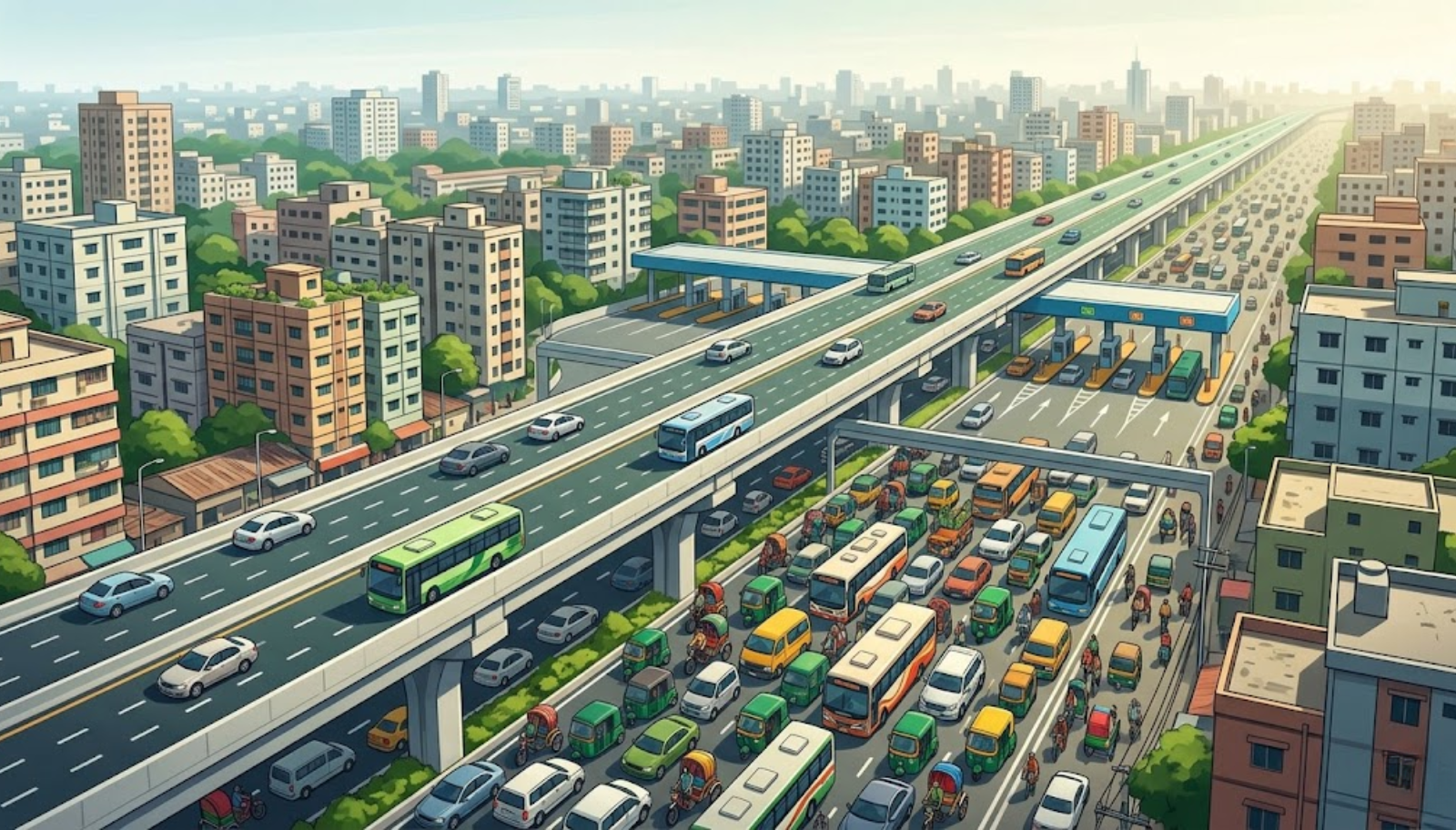
The Dhaka Elevated Expressway (DEE) is a high-capacity, grade-separated corridor designed to efficiently navigate the city above surface-level congestion. This ambitious transport intervention is a significant addition to the capital’s infrastructure. The long-term efficacy of this infrastructure is contingent not only on its own characteristics but also on the broader policy environment in which it operates.
What the Expressway Can Achieve
At its most straightforward, the DEE adds significant corridor throughput that surface roads cannot match. For long-distance through traffic navigating congested city streets, the access-controlled elevated route offers faster journeys and crucially, more predictable travel times. During peak periods, the expressway is likely to reduce pressure on parallel arterial roads, potentially cutting tens of minutes from select commutes for private vehicles and buses with access to entry ramps.
The benefits are particularly evident in the areas of freight and intercity travel. Truck and bus operators stand to gain the most from this technology, as it directly reduces logistics costs and improves scheduling by decreasing the number of stops and signal delays. Access to the airport is expected to improve significantly. These are significant gains for an economy where supply chain efficiency is a key factor in competitiveness.
Safety is another anticipated benefit. By separating fast-moving traffic from the pedestrians, rickshaws, and local vehicles that characterise Dhaka’s surface streets, the elevated corridor reduces the frequency of dangerous interactions. Smoother, more consistent driving speeds may also lower emissions per trip though total environmental outcomes will depend heavily on how much additional vehicle travel the new road encourages.
The Limits of Elevated Road Capacity
International experience has demonstrated that increasing road capacity alone does not provide a long-term solution to urban congestion. The well-documented phenomenon of induced demand, whereby an increase in road space leads to an uptick in vehicle trips that gradually fill the new capacity, means that surface congestion can rebound even as a new expressway opens. Short, local journeys will derive limited benefit from the DEE, and road space freed at ground level may be quickly absorbed by new motorized traffic rather than by pedestrians or cyclists.
For the expressway to maintain its initial benefits, it is essential that it is integrated into a comprehensive demand-management strategy. Integrating the DEE with ongoing mass transit expansion, including the Dhaka Metro and Bus Rapid Transit, along with enhancements to last-mile connectivity, is poised to shift the urban transportation landscape, reducing car dependency while enhancing accessibility and efficiency. Congestion pricing, parking reform, and incentives to shift freight and passenger flows off-peak are all tools that would prevent induced demand from neutralizing the expressway’s contribution.
Revenue Realities and Financial Risks
The DEE is financed through a combination of public funds, loans, and private-sector participation, with toll revenues projected to cover operational costs and service debt. Tolling makes sense as a user-pays mechanism and can help moderate demand. However, global experience with urban highway projects offers a sobering caution: traffic forecasts are frequently over-optimistic, and revenue shortfalls can quickly translate into fiscal stress for government backers or private concessionaires. Conservative modelling that accounts for price elasticity and possible modal shifts is therefore essential from the outset, with ridership sensitivity analyses and contingency plans built into financial agreements.
Equity is an equally pressing concern. Toll charges that are manageable for middle-income commuters may be prohibitive for lower-income residents, who simultaneously face longer and slower surface journeys because of being priced out. Discounted passes, exemptions for essential services, and continued investment in affordable public transport alternatives are necessary to ensure the expressway does not deepen existing mobility inequalities. Transparent allocation of toll revenues toward maintenance and broader transport improvements will also be critical for sustaining public acceptance over time.
A Component, not a Cure
Elevated structures carry higher lifecycle maintenance costs than surface roads, and failure to fund upkeep adequately undermines both safety and revenue-generating capacity over time. Contractual arrangements must include clear maintenance obligations and contingency provisions to avoid the deterioration that has afflicted comparable projects elsewhere.
The Dhaka Elevated Expressway is a valuable piece of the city’s transport infrastructure. However, for it to be effective, it must be incorporated into a comprehensive urban mobility strategy. Implemented independently, it may offer only transient congestion relief and potentially lead to long-term financial challenges. When viewed as a comprehensive strategy that integrates mass transit investment, demand management, equitable tolling, and disciplined financial governance, it becomes a significant and sustainable contribution to enhancing the liveability of Dhaka and the productivity of its economy.

