
Desk Report
Oniket Desk
Bangladesh is one of the most densely populated and climate-vulnerable nations on Earth. Its rivers, wetlands, and coastal forests are not merely ecological assets. They are existential shields against flooding, cyclones, salinity intrusion, and the accelerating consequences of climate change. Yet the country’s forest cover has been shrinking, urban green spaces are vanishing under concrete, and the ambition expressed in national plantation policies has consistently outpaced its delivery. As the 2030 deadline for the United Nations Sustainable Development Goals draws near, the question is no longer whether Bangladesh has a green vision, but whether it has the institutional will and structural capacity to realize one.
The State of Forest Cover and Urban Greenery
Official statistics in Bangladesh have long claimed a forest cover of approximately 17 percent of total land area. Independent assessments and satellite data, however, suggest the actual figure of ecologically functional forest (as distinct from monoculture plantation, roadside tree lines, and homestead vegetation counted in official tallies) is considerably lower.
The Sundarbans, the world’s largest mangrove ecosystem and a UNESCO World Heritage Site shared with India, faces mounting threats from rising sea levels, upstream freshwater diversion, and illegal logging. Hill forests in the Chittagong Hill Tracts have experienced significant degradation over decades of encroachment and land conversion. Meanwhile, Bangladesh’s rapidly expanding cities (Dhaka in particular) are among the most tree-deficient urban environments in Asia, with green space per capita falling far below internationally recommended standards.
Bangladesh and the UN SDG Framework
The UN Sustainable Development Goals most directly relevant to Bangladesh’s plantation and greenery agenda include SDG 15, which calls for the protection, restoration, and sustainable use of terrestrial ecosystems and forests; SDG 13, which demands urgent action on climate change; and SDG 11, which envisions inclusive, safe, and sustainable cities with accessible green public spaces. Bangladesh is a signatory to all SDG commitments and has formally integrated the 2030 Agenda into its national planning architecture, including successive Five-Year Plans and the Delta Plan 2100.
However, the gap between commitment and performance remains wide. SDG 15 targets require not only maintenance but the net expansion of forest cover and biodiversity. Bangladesh’s deforestation rate, driven by agricultural expansion, urban sprawl, shrimp farming in coastal zones, and infrastructure development, continues to undermine these targets. Progress on SDG 11’s urban greenery indicators has been particularly poor, with city corporations lacking both the land reserves and the governance frameworks needed to create and protect public parks, tree corridors, and green buffers.
Government Policy: Alignment and Gaps
The present government has launched several plantation-related initiatives, including national tree plantation campaigns, coastal greenbelt development programs, and targets to increase forest cover to 20 percent of land area. The National Forest Policy and the Forestry Master Plan articulate broadly SDG-aligned objectives around biodiversity conservation, community forestry, and climate resilience. The Mujib Climate Prosperity Plan, unveiled as Bangladesh’s long-term climate response strategy, further commits to large-scale afforestation and ecosystem restoration.
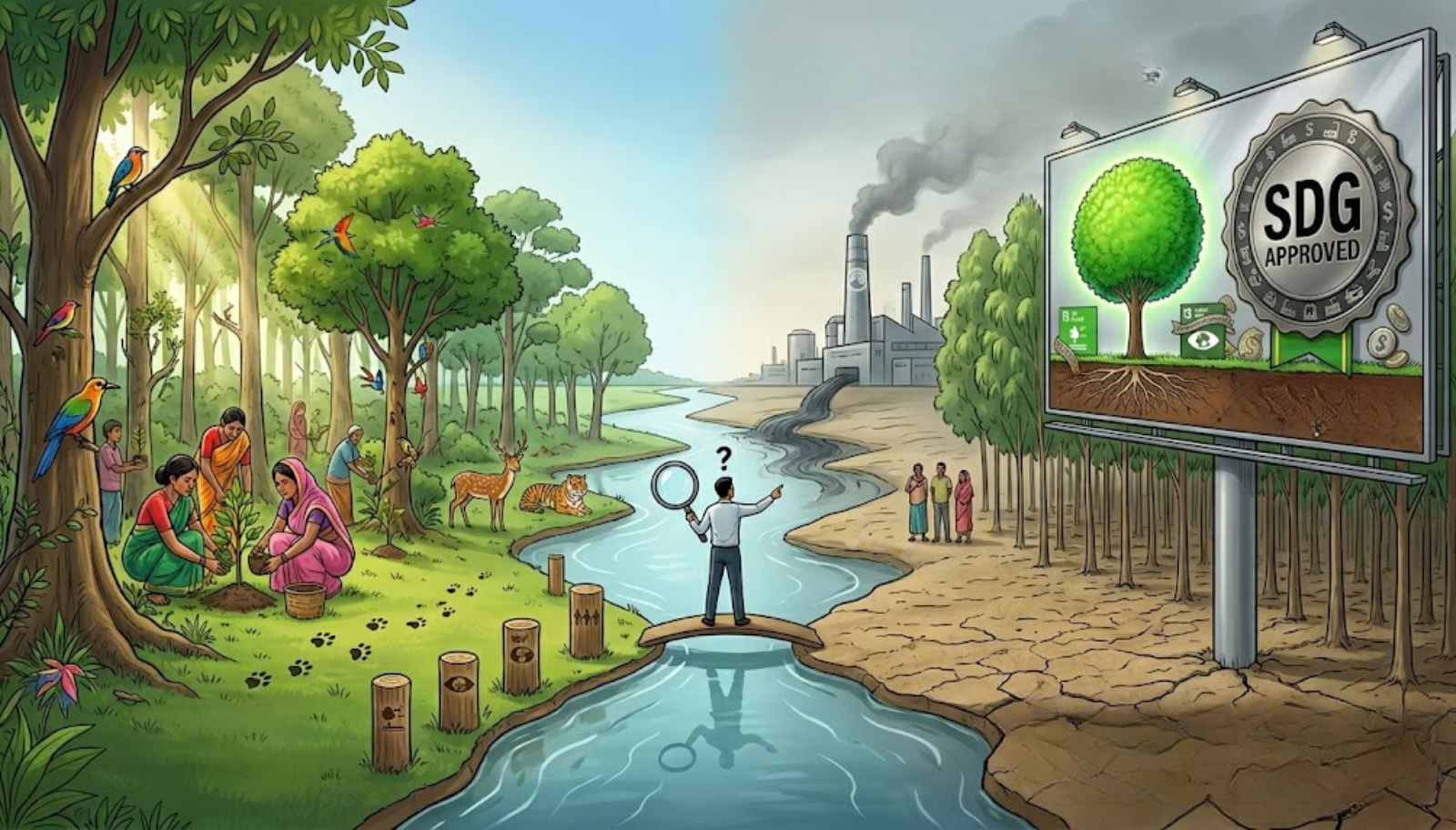
Yet these policies suffer from a series of structural deficiencies. Target-setting has often been supply-driven, focused on the number of saplings planted rather than survival rates, ecological suitability, or long-term canopy development. Monoculture plantation of commercially preferred species produces headline numbers without delivering meaningful biodiversity or ecosystem services. Inter-ministerial coordination between the Forest Department, the Ministry of Environment, city corporations, and the Roads and Highways Division remain weak, leading to contradictory outcomes where afforestation programs proceed in one sector while road and infrastructure projects clear mature trees in another.
Policy Challenges
The core challenges confronting Bangladesh’s green agenda are simultaneously technical, political, and cultural. Land scarcity in one of the world’s most densely populated countries means that forest conservation directly competes with agricultural, residential, and industrial land use. Political economy pressures frequently favor short-term development over long-term ecological sustainability. Community forest rights remain poorly defined, reducing local stakeholder investment in conservation outcomes. Additionally, climate finance flows, though improving, have not yet translated into the scale of on-the-ground restoration investment that Bangladesh’s ecological vulnerability demands.
The Way Forward
Achieving exemplary success by 2030 will require a fundamental reorientation of approach. First, Bangladesh must shift from quantity-based plantation metrics to quality-based ecological restoration benchmarks such as measuring canopy cover, species diversity, and ecosystem health rather than saplings distributed. Second, urban greening must be codified in law through mandatory green space ratios in city master plans, with dedicated financing mechanisms for urban forestry and the legal protection of existing mature trees from commercial clearance.
Third, community-based forest governance models must be systematically scaled, empowering local populations, particularly indigenous and coastal communities, as primary custodians of forest resources, with clearly defined tenure rights and revenue-sharing arrangements. Fourth, a centralized, publicly accessible real-time monitoring system using satellite imagery and ground verification must be established to hold all government departments accountable to declared plantation and conservation targets.
Bangladesh has the policy language, the international commitments, and the ecological urgency to lead on green restoration in the developing world. What it requires now is the institutional discipline to close the gap between declaration and delivery before 2030 renders the opportunity history rather than ambition.