
Ameera Haidar
Architect
Dhaka is one of the fastest-growing megacities in the world, and one of the most structurally precarious. As the Rajdhani Unnayan Kartripakkha (RAJUK) continues to oversee the planning and construction governance of Bangladesh’s capital, the question of whether its residential and commercial building policies are fit for purpose has become a matter not merely of urban planning but of public safety and national survival.
Decades of regulatory compromise, enforcement failure, and short-term development thinking have produced a city whose built environment is acutely vulnerable to fire, seismic activity, and other natural hazards. Without a fundamental reorientation of construction policy and its implementation, Dhaka’s growth trajectory is not a path to prosperity, it is a path to compound disaster.
RAJUK’s Mandate and Its Structural Failures
RAJUK’s formal mandate under the Town Improvement Act and the successive Dhaka Structure Plans is comprehensive on paper. The authority is charged with regulating land use, approving building plans, enforcing construction standards, and guiding the city’s spatial development in accordance with designated residential, commercial, and industrial zones. The Detailed Area Plans, which divide Dhaka into land-use categories and specify setback requirements, floor area ratios, and permissible building heights, represent a technically sophisticated planning framework by regional standards.
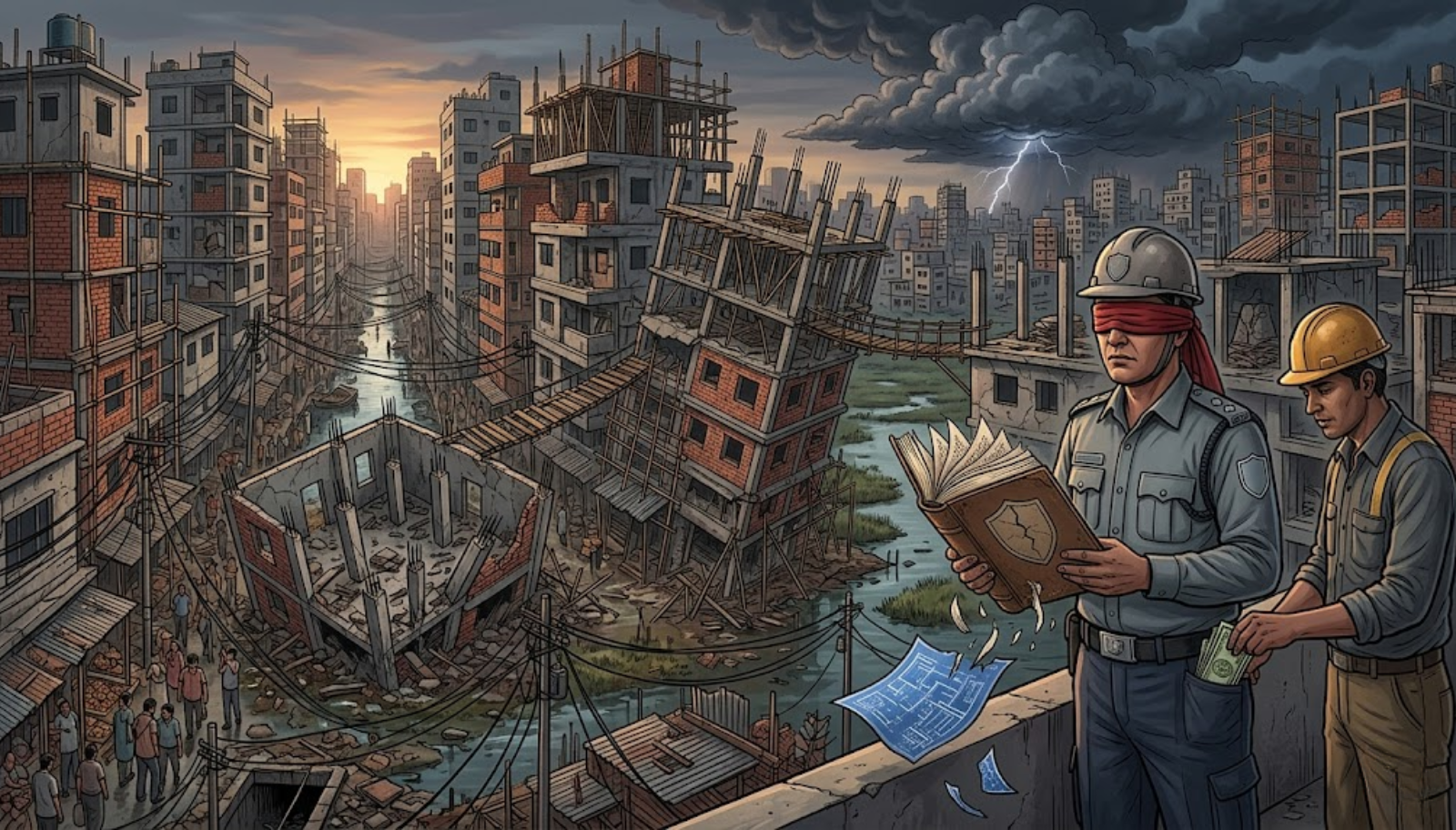
The implementation reality, however, represents one of the most consequential governance failures in Bangladesh’s urban history. Unauthorized floor additions are routine across both residential and commercial buildings. Setback violations (where buildings encroach on the space intended to allow emergency access, natural light, and ventilation) are so widespread as to have become the architectural norm rather than the exception. Building plan approvals are obtained for one design and executed for another. Occupancy certificates are granted without rigorous structural or safety inspection. The culture of enforcement, where it exists at all, is episodic and reactive, triggered by disaster rather than sustained as prevention.
Fire: The Ever-Present Danger
Dhaka’s record of catastrophic building fires over the past two decades is a direct indictment of its construction governance. From the Nimtoli tragedy to the Chawkbazar fire and the repeated disasters in garment and commercial buildings, the pattern is consistent: buildings without adequate fire exits, stairwells blocked or converted into storage, electrical wiring installed without safety compliance, fire suppression systems absent or non-functional, and emergency vehicle access obstructed by encroachment on surrounding roads and open spaces.
These are not unpredictable events. They are the logical outcomes of a construction policy that approves buildings without enforcing fire safety compliance, and a regulatory culture that treats post-disaster inquiry as a substitute for pre-disaster prevention. Commercial buildings in Old Dhaka and new high-rises in Gulshan alike demonstrate the same structural indifference to fire safety that has already cost hundreds of lives. RAJUK’s building approval process does not currently function as a meaningful fire safety gate, and until it does, the next mass casualty fire is a matter of statistical certainty, not possibility.
Earthquake Risk: A Slow-Motion Emergency
Bangladesh sits within a seismically active region. Dhaka lies in moderate-to-high seismic hazard zones, and the geological record (combined with regional seismic modeling) suggests the city faces a significant probability of a major earthquake within coming decades. The consequences of such an event for Dhaka’s current built environment would be catastrophic. A substantial proportion of the city’s building stock, including older residential structures, informally constructed multi-storey buildings, and commercial complexes built with sub-standard materials, would not survive a moderate earthquake, let alone a major one.
Despite this documented risk, seismic safety provisions within RAJUK’s approval and inspection framework remain inadequately enforced. Soil testing, structural engineering certification, and earthquake-resistant design standards are required on paper but inconsistently applied in practice. The construction industry’s widespread use of underspecified materials, including substandard concrete mixes and insufficient rebar, is an open secret that RAJUK’s inspection regime has not effectively addressed. Bangladesh has already witnessed how a single building collapse, at Rana Plaza in 2013, can kill over a thousand people. A major earthquake striking central Dhaka under current conditions would represent a humanitarian catastrophe of an entirely different scale.
The UN SDG Dimension
The connections between RAJUK’s construction policy failures and Bangladesh’s SDG commitments are direct and serious. SDG 11 (Sustainable Cities and Communities) calls explicitly for inclusive, safe, resilient, and sustainable human settlements, with specific targets around disaster risk reduction, accessible housing, and participatory urban planning. SDG 13 demands urgent climate action and integration of disaster risk into national planning. SDG 3, which addresses good health and well-being, is implicated every time a preventable fire or structural collapse takes lives. SDG 16’s emphasis on accountable and effective institutions applies squarely to a planning authority whose enforcement record falls consistently short of its regulatory mandate.
Bangladesh has embedded the SDGs within its national development architecture, but the persistent gap between RAJUK’s regulatory framework and its enforcement practice means that Dhaka’s urban development trajectory actively contradicts the SDG vision rather than advancing it. Sustainable urbanization cannot be achieved through aspirational planning documents alone. It requires the institutional will and capacity to enforce standards before disasters occur, not investigate them afterward.
What Must Change: Policy and Implementation Reforms
The path to a safer and more sustainable Dhaka requires reform across several interconnected fronts. First, RAJUK must be fundamentally restructured as a genuinely independent regulatory authority, insulated from political interference and corruption, with professional staffing commensurate with the scale and complexity of its oversight mandate. The chronic practice of approving non-compliant buildings in exchange for informal payments must be addressed through transparent, digitized approval processes, mandatory third-party structural inspection, and severe professional consequences for non-compliant approvals.
Second, a comprehensive national urban building retrofit program must be urgently designed and funded, prioritizing the seismic and fire safety upgrades of the highest-risk building stock in Dhaka’s most densely populated areas. This is not a task for RAJUK alone. It requires coordinated engagement between the Ministry of Housing, the Ministry of Disaster Management, city corporations, and the private construction sector, backed by accessible financing mechanisms for lower-income building owners.
Third, fire safety compliance must become a non-negotiable condition of both initial occupancy certification and periodic re-certification, covering functional fire exits, suppression systems, evacuation plans, and unobstructed access routes. Buildings that fail periodic inspection must face mandatory remediation with legally enforced timelines.
Fourth, public awareness and community-level disaster preparedness must be institutionalized. Citizens, building owners, and tenants must understand their rights, their responsibilities, and the evacuation procedures relevant to their buildings. This is to be done not as a voluntary initiative, but as a structured element of urban safety governance.
RAJUK’s construction policy as currently practiced is not building Dhaka’s future. It is mortgaging it. Each unauthorized floor, each blocked fire exit, and each uninspected foundation represent a deferred catastrophe. The SDGs provide both the ethical framework and the practical architecture for a different approach: one in which urban growth is inseparable from resilience, safety, and accountability. Dhaka has the density, the economic dynamism, and the civic talent to become a model of sustainable urbanization in the developing world. But that future requires the political courage to enforce the standards that already exist, before the next disaster makes the cost of inaction impossible to ignore.