
Desk Report
Oniket Desk
In a country where millions of people live with physical, sensory, or cognitive disabilities, and where an ageing population, injury from road accidents, and the consequences of natural disasters add millions more to the ranks of those with mobility and access needs, the question of accessibility is not a niche concern. It is a fundamental question of citizenship.
Yet in Bangladesh, access to public facilities, private buildings, roads, and transport remains one of the most systematically neglected dimensions of human rights policy, leaving a vast segment of the population excluded from the basic rhythms of civic and economic life.
The Legal Framework: Rights on Paper
Bangladesh has made meaningful formal commitments to disability rights and accessibility. The country ratified the United Nations Convention on the Rights of Persons with Disabilities in 2007, and the Rights and Protection of Persons with Disabilities Act of 2013 represents a significant legislative milestone, enshrining the principle of reasonable adjustment and non-discrimination. The National Building Code contains provisions for accessible design in public and commercial structures, including ramps, accessible toilets, and designated parking. On paper, the architecture of rights exists.
The implementation reality, however, is starkly different. Regulatory provisions are rarely enforced. No dedicated and empowered inspectorate systematically audits compliance with accessibility standards across new constructions or existing buildings. Penalties for non-compliance are minimal and infrequently applied. The result is a body of law that has thus far functioned as symbolic aspiration than enforceable entitlement.
Public Facilities: Exclusion by Design
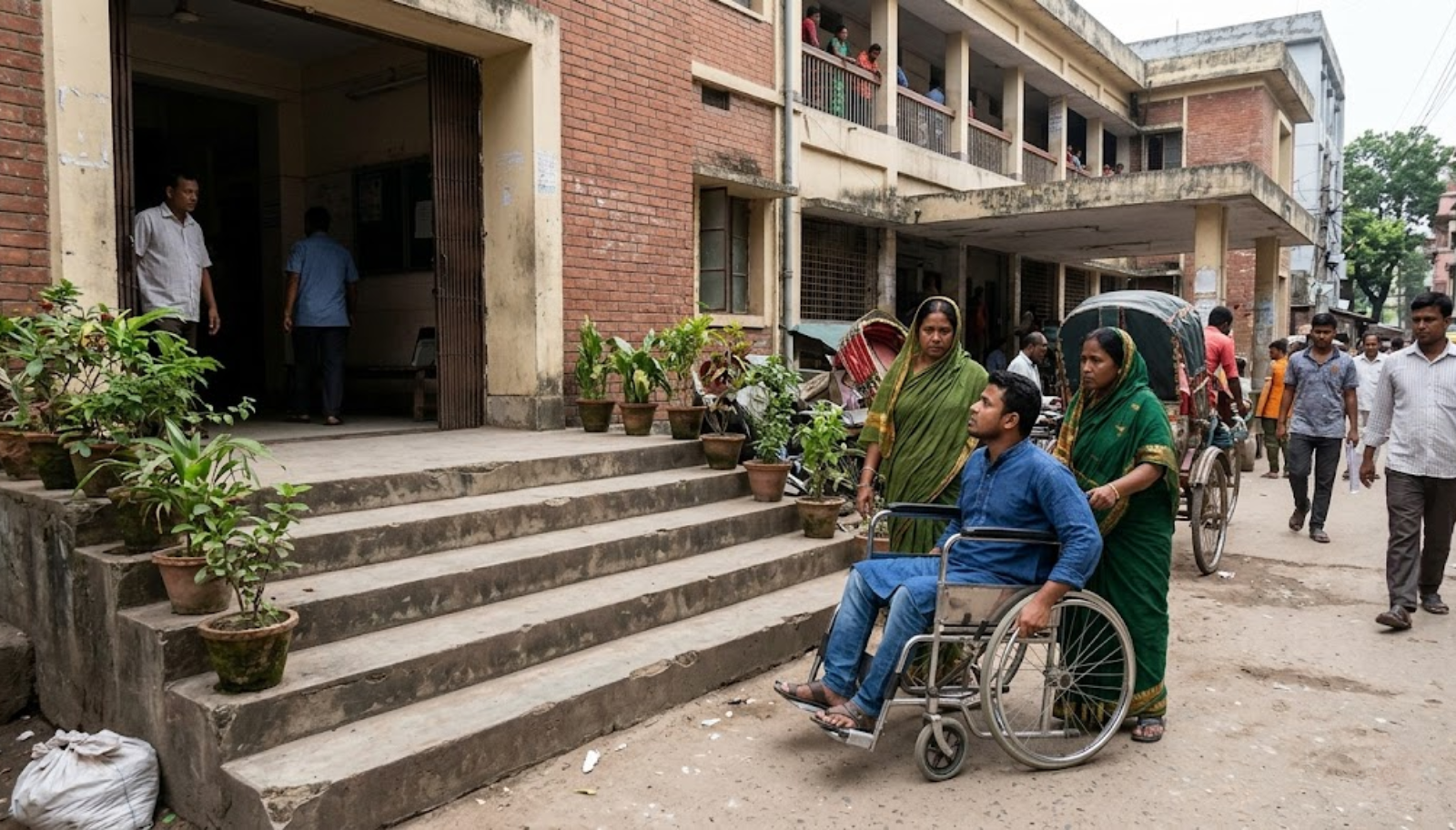
Government offices, hospitals, courts, educational institutions, and public markets (the spaces through which citizens exercise their most fundamental rights) remain overwhelmingly inaccessible to people with disabilities. Steps without ramps, narrow doorways impassable by wheelchairs, absent or non-functional lifts, and inaccessible toilet facilities are the norm rather than the exception, even in newly constructed public buildings. Signage in Braille or accessible audio formats is virtually nonexistent. Public spaces designed to serve all citizens are, in practice, designed for the able-bodied majority alone.
The situation in healthcare infrastructure is particularly alarming. Hospitals, the very institutions that people with physical disabilities depend on most, routinely fail accessibility standards. Examination tables, diagnostic equipment, and consultation rooms are frequently physically unreachable for patients’ wheelchairs or other mobility aids. For a nation that presents itself as advancing in human development indicators, this constitutes a profound structural contradiction.
Private Buildings: An Unregulated Frontier
The private sector presents an even more challenging terrain. Commercial buildings, shopping centres, restaurants, banks, and private offices are developed with almost no systematic adherence to accessibility requirements. Developers and property owners face negligible pressure (legal, financial, or reputational) to incorporate universal design principles. Building permits are issued without rigorous accessibility review. The concept of reasonable adjustment, the legal obligation to modify environments and practices to accommodate persons with disabilities, is barely understood, let alone practiced, within Bangladesh’s private construction and business ecosystem.
Roads and Transport: A Daily Obstacle Course
For most citizens with disabilities, the journey to any destination begins with an obstacle course. Footpaths, where they exist, are routinely occupied by vendors, motorcycles, and construction materials, rendering them impassable for wheelchair users or those with visual impairments. Kerb cuts, the sloped transitions between pavement and road level that form the most basic infrastructure of accessible urban movement, are absent from the vast majority of Bangladesh’s road network, including in Dhaka.
Public transport compounds the exclusion. Buses lack low-floor boarding, wheelchair spaces, or audio-visual announcements. The Dhaka Metro Rail, a significant recent infrastructure investment, has incorporated some accessibility features, representing a positive precedent. But it remains an isolated example in a transport ecosystem that is overwhelmingly inaccessible. Rickshaws, CNGs, and ride-share applications provide limited accommodation for passengers with significant mobility needs, and no regulatory framework currently mandates otherwise.
What Must Be Done
Transforming accessibility from legal text to lived reality requires coordinated action across governance, infrastructure, and culture. First, accessibility compliance must become a non-negotiable condition of building permit approval and occupancy certification for all public and commercial constructions, with mandatory independent accessibility audits conducted before certification is granted. Second, a rolling national retrofit program must be established and adequately funded to bring existing government buildings, hospitals, schools, and transport hubs into conformity with universal design standards within a defined timeframe.
Third, the Roads and Highways Division and city corporations must adopt and enforce mandatory accessible infrastructure standards covering all new road construction, including continuous kerb cuts, tactile paving for visually impaired pedestrians, and protected accessible footpaths. Fourth, transport regulators must introduce enforceable accessibility requirements for all licensed public transport operators, with phased compliance deadlines and public subsidy incentives for early adoption.
Fifth and critically, the National Council for Persons with Disabilities must be transformed from a consultative body into a regulatory authority with real investigative powers, the capacity to receive and adjudicate complaints, and the mandate to impose meaningful sanctions. Disability rights organizations and people with lived experience must be placed at the center of policy design, not its periphery.
Accessibility is not a privilege extended by the state to a deserving minority. It is a right owed by society to every citizen. Bangladesh’s failure to deliver accessible public infrastructure, enforce reasonable adjustment obligations in the private sector, and build roads and transport systems usable by all is not a resource problem alone. It is a failure of political priority. Reversing it demands the recognition that a city, a building, or a transport system that excludes any citizen by design is, by definition, incomplete. The ramp, the kerb cut, and the accessible toilet are not architectural extras, they are the physical grammar of equal citizenship.