
Hasan Hamid
CUET
Few countries are better positioned to benefit from solar energy than Bangladesh. Sitting within a high-irradiance solar belt, receiving abundant sunlight for much of the year, and facing rapidly growing electricity demand driven by urbanisation and rising living standards, the country has both the resource and the motivation to make solar power a cornerstone of its energy future.
The shrinking cost of photovoltaic technology has only strengthened that case. Yet turning geographic advantage into lasting energy security will require far more than installing panels; it demands a coherent, reform-driven strategy that addresses finance, infrastructure, land, industry, and social equity simultaneously.
Bangladesh has already demonstrated that large-scale solar deployment is achievable. Its off-grid solar system programme has electrified millions of rural households, and several utility-scale projects and public-private partnerships are now underway. These successes, however, have reached a ceiling.
Private investors remain cautious, deterred by financing gaps, high perceived risks, and a regulatory environment marked by inconsistent tariff frameworks, lengthy approval processes, and unpredictable procurement. The grid itself presents further constraints: limited storage capacity and outdated infrastructure make it difficult to absorb the variable output that solar generation produces, creating curtailment risks that undermine the economics of new projects. Land scarcity adds another layer of complexity, as large-scale solar parks inevitably compete with agriculture and habitation in one of the world’s most densely populated countries.
Overcoming these barriers begins with regulatory clarity. Bangladesh needs long-term, technology-neutral renewable energy targets and phased procurement roadmaps that send credible signals to investors. Permitting and land acquisition processes should be consolidated into streamlined, digital single-window systems with standardised contracts, reducing the delays that currently inflate project costs and test developer patience. Stable tariff mechanisms, including long-term power purchase agreements and competitive auctions with transparent rules, would substantially reduce investment risk without sacrificing consumer protection.
On the financing side, blended facilities that combine concessional loans, guarantees, and equity can lower capital costs and draw in institutional investors who currently find Bangladesh’s solar market too uncertain. Green banking products, local-currency financing to reduce foreign exchange exposure, and pay-as-you-go models for rooftop systems would extend solar’s reach to households and small businesses that cannot access conventional credit. Grid modernisation (smart meters, digital controls, upgraded distribution networks, and expanded battery storage) must proceed in parallel, ensuring that growing solar capacity translates into reliable electricity rather than wasted generation.
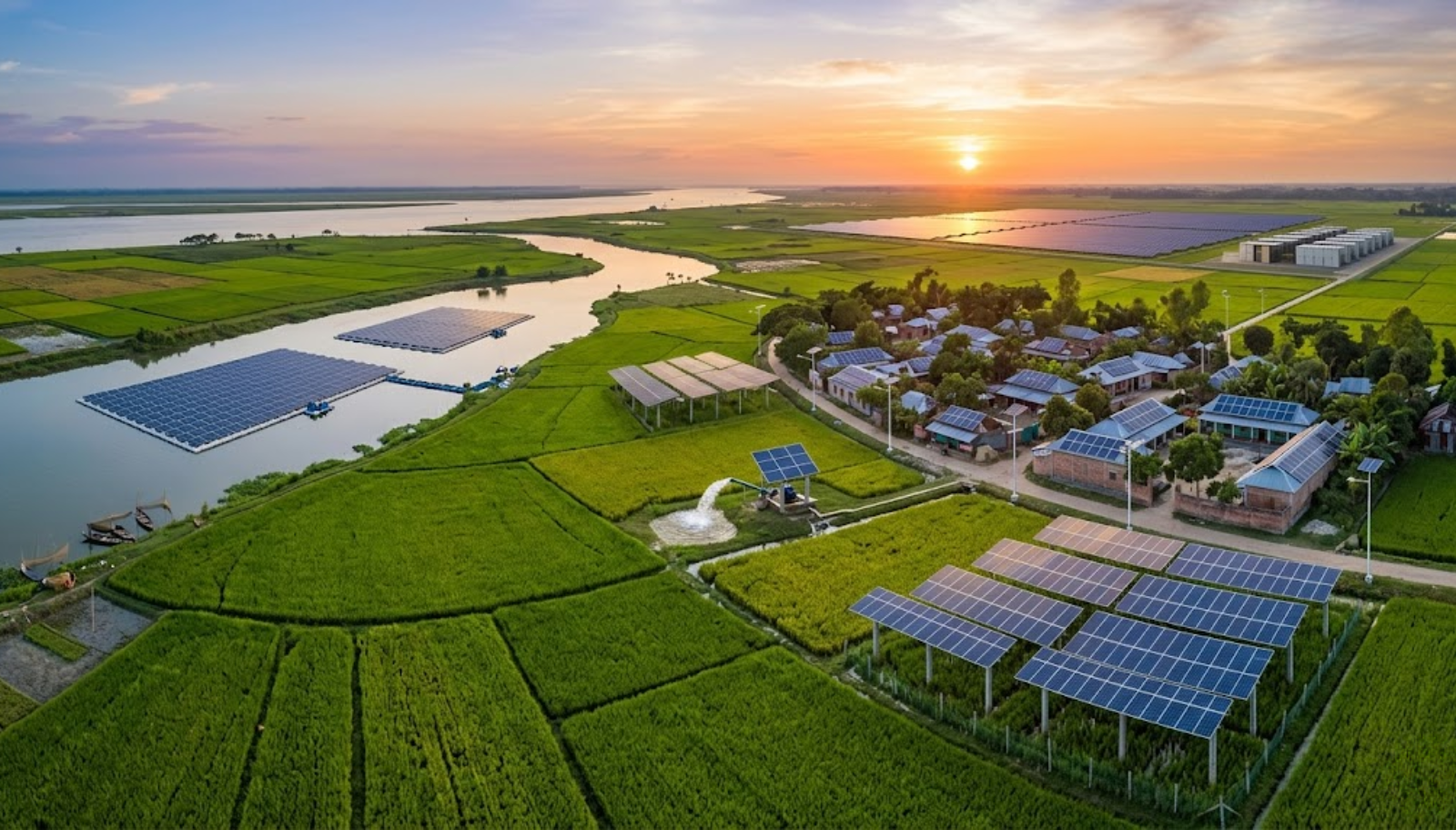
Land-smart deployment offers a practical path around the scarcity problem. Floating solar on reservoirs and canals, agrivoltaic systems that allow crops and panels to share the same land, rooftop installations on urban and industrial buildings, and targeted use of degraded lands and brownfields can collectively deliver substantial capacity without displacing food production or communities. Where grid extension remains uneconomic, community-scale microgrids can bring clean power to the most remote areas.
Crucially, none of this will deliver its full promise unless the benefits are shared. Local manufacturing of solar components, workforce training programmes, community ownership models, and subsidies targeted at low-income households can ensure that Bangladesh’s solar transition creates jobs and reduces energy poverty rather than concentrating gains among those already well-served. Environmental safeguards covering site assessment, end-of-life panel recycling, and biodiversity protection will ensure that the clean energy revolution does not generate its own ecological costs. Bangladesh’s sunlight is abundant and democratic; its energy policy should be too.