
Wahidul Mallik
DTech Bangladesh
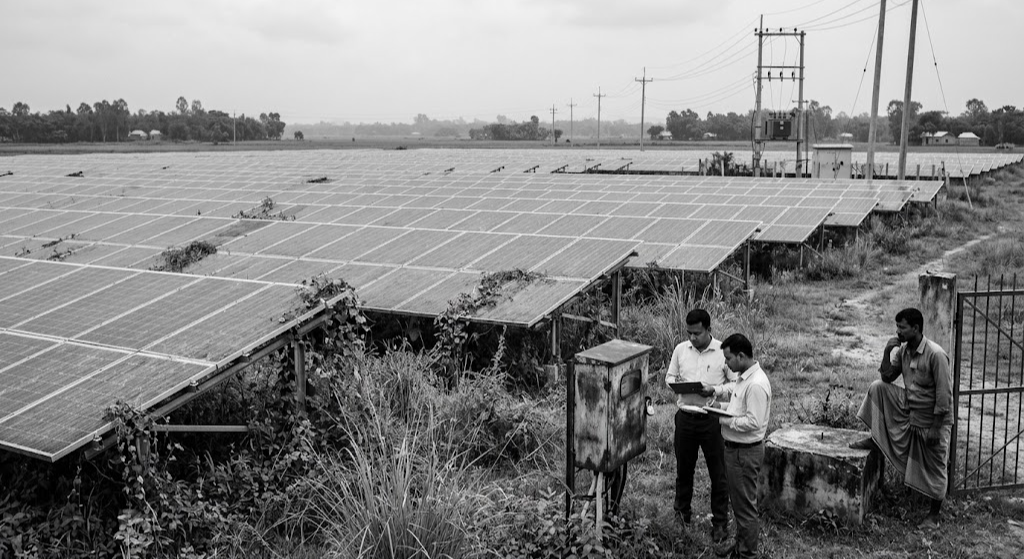
Beside a river char in Jamalpur sits a solar plant that was meant to feed the grid and instead feeds a dispute. The 100MW Madarganj project, under implementation since 2021 on about 317 acres in Kaijar Char, has stood suspended since November last year (sourced from BBS). Its contractor says roughly Tk 212 crore in bills remains unpaid. Solar modules totalling 50MW reached the site in July last year and still have not been installed, because the implementing agency has not completed the inspection required after landing. A project built to add clean electricity is, for now, adding nothing.
These appeared in national dailies in Bangladesh, during last week. What was not discussed in those features is the point of this article.
What Happened
The facts reported in the national dailies are troubling in their simplicity. The implementing agency, Rural Power Company Limited, has withheld the contractor’s bills for nearly a year. Work stopped. Then, in August, the government approved a revised project proposal that cut the cost to Tk 1,612 crore, removing work worth nearly Tk 200 crore after about 60 percent of the project had been completed.
According to the contractor, neither it nor the Swiss consultancy involved was consulted. Excluded items reportedly include a static VAR generator, a module cleaning system and various electrical equipment. When a delegation from the agency visited the site, it declined to answer questions on the cost cuts, repeated design changes, unpaid bills and slow progress.
A Careful Word on Corruption
The public media reports allege no bribery or embezzlement, and fairness requires saying so. What it documents is mismanagement, opacity and a refusal to explain, which is precisely where corruption thrives. When payments are withheld without justification, designs keep shifting and officials stay silent, citizens cannot tell incompetence from impropriety. Transparency exists to make that distinction possible. Bangladesh’s power sector, with its history of inflated capacity payments and opaque rental contracts, has taught the public to read secrecy as a warning sign, and every stalled project inherits that suspicion.
Why Management Failure Starves Supply
A power plant generates nothing until it is built, tested and connected to the grid, so each month of delay means generation is permanently lost. The shortfall has to be covered by imported fuel or expensive rental plants, and the cost lands on both the public budget and household bills. The local effects are immediate: regions waiting on the new supply continue to endure load shedding, sagging voltage and erratic service, while farmers, small manufacturers and families make plans around a plant that never starts.
The decision to trim the project’s scope adds a second risk. Equipment that keeps a plant stable and efficient, including reactive power support and panel-cleaning systems, is not optional. Dust-covered panels produce less, and a grid without adequate voltage control becomes prone to instability. What looks like a savings today can turn into losses over the plant’s decades of operation. A plant finished in stripped-down form is not a real contribution to clean energy; it is a monument to short-term accounting.
Withholding Tk 212 crore from contractors compounds the damage. It weakens the finances of the firms prepared to build in Bangladesh, pushes up the risk premium they will attach to future bids, and tells investors that contractual promises may not be kept. Since the country’s renewable energy targets rely on precisely those investors, the cost of the withheld payment could far exceed the sum itself.
The Ministry’s Missing Initiative
As far as the public record shows, the ministry has only reacted. A revised proposal was approved, yet no one has explained why work was cut after the project was 60 percent complete, who made that call, what technical evidence supported it, or what will happen to the components left out. No audit of the payment delay has been announced, and there is no timeline for installing the modules already sitting on site.
The pattern matters well beyond this one project. A ministry serious about curbing corruption would not wait for the press to start asking questions. It would publish payment schedules along with the reasons for any delay, require an independent technical review before scope is reduced, enforce deadlines for inspections, and make agency officials personally answerable for stoppages they cannot explain. When officials stay silent about a project paid for with public money, that silence should itself prompt an inquiry rather than go unremarked.
Several reforms would help prevent a repeat. Every power project above a defined size should carry a public dashboard showing its cost, stage of completion, payments made and pending, and the reasons behind any revision, so that problems surface through routine disclosure rather than press scrutiny. Where scope is cut after substantial progress, an independent review and a written justification should be mandatory, which would have forced someone to explain the Madarganj decision before work was stripped out. Payment disputes, meanwhile, need a fast and neutral resolution mechanism, so that projects do not freeze while the parties argue over invoices. That discipline must extend to officials too: those who withhold information or delay approvals without cause should face real consequences, since delay without accountability is how a stoppage becomes a pattern. Finally, an independent audit of Madarganj should be published whatever it finds, because only then can the public judge whether the lessons have been learned.
Conclusion
Bangladesh cannot meet its renewable energy ambitions with panels stacked in storage and contractors unpaid. Reliable electricity is built by honest management, timely payment and open accounts as much as by engineering. Madarganj asks the ministry a plain question: will it explain, investigate and act before the next project meets the same fate? Until it does, the lights in Jamalpur will remain a promise.