
Ameera Haidar
Freelance Architect
Bangladesh is a nation defined by water. More than seven hundred rivers thread across its territory, the Bay of Bengal borders its south, and the world’s largest river delta shapes its very geography. Yet for decades, the cities built atop this vast water network have treated water as a threat to be managed away rather than an asset to be designed around. The concept of “blue cities”, urban centers organized around water rather than despite it, offers Bangladesh a genuinely transformative framework for the decades ahead. This article explores the prospects of blue cities in Bangladesh.
What Blue Cities Are
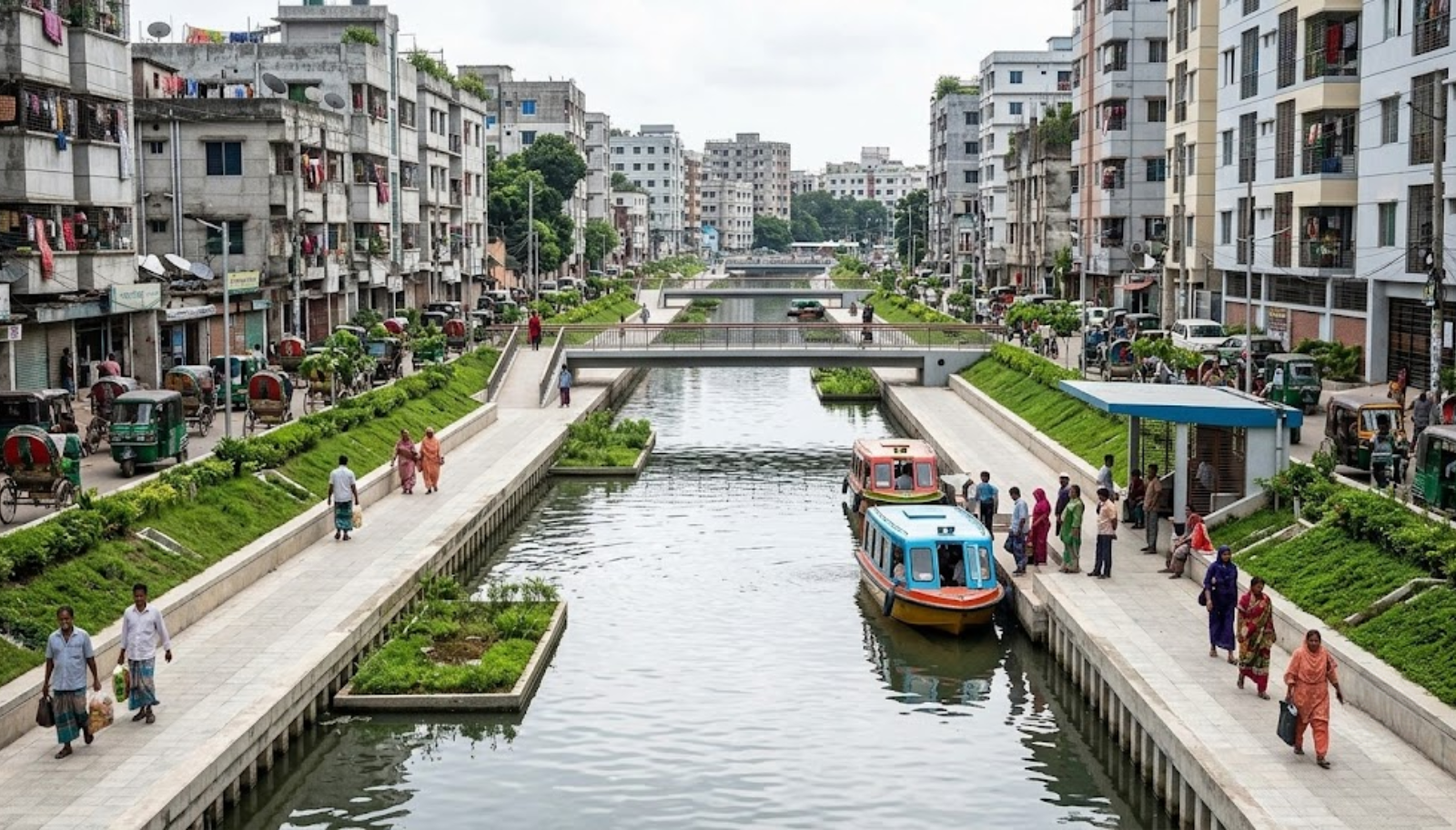
Blue cities place water at the center of planning, infrastructure, and economic life. Rather than channeling stormwater away as quickly as possible and treating rivers and canals as obstacles to be filled or piped underground, they retain, manage, and actively design around water. The model draws heavily on China’s “sponge city” approach, where permeable surfaces, bioswales, rain gardens, and retention ponds allow urban areas to absorb excess rainfall and release it gradually reducing flood risk, replenishing groundwater, and cooling city environments in the process.
Why Bangladesh Is a Natural Fit
Few countries can make as strong a case for this model as Bangladesh, for two distinct reasons: acute vulnerability and untapped opportunity.
On the vulnerability side, up to three-quarters of the country’s land floods during the monsoon, a figure driven as much by policy failure as by climate. Dhaka’s growth has come at the expense of hundreds of natural canals and wetlands that once served as drainage corridors. In Khulna, the Mayur River, historically the city’s main stormwater outlet, has been squeezed by illegal encroachment and waste dumping, leaving the city prone to prolonged waterlogging. As permeable ground gives way to concrete faster than drainage infrastructure can keep pace, the results are predictable: flooded streets, stagnant water, disease, and economic disruption, year after year.
On the opportunity side, Bangladesh sits on a maritime asset it has barely begun to use. Its exclusive economic zone in the Bay of Bengal spans nearly 119,000 square kilometers, secured through landmark international rulings. A seven-hundred-kilometer coastline is home to the ports of Chattogram, Mongla, and Payra, with the Matarbari deep-sea port currently under construction. The blue economy, comprising fisheries, shipping, coastal tourism, and offshore energy, already employs over seventeen million people, yet remains far below its potential, held back in part by the same water mismanagement plaguing the country’s inland cities.
This is the real insight of the blue city framework: Bangladesh’s flooding crisis and its underused maritime economy are not separate problems. They are two sides to the same failure to design cities around water, and a single organizing principle could address both.
Cities Ready for Transformation
Several cities are natural candidates. Khulna is already the subject of sponge-city research proposing the restoration of the Mayur River, permeable public spaces, and riverbank areas that double as recreation zones in dry seasons and floodplains during monsoons. Narayanganj, once known as the “Dundee of Bengal” and threaded by the Shitalakshya and Buriganga rivers, has seen early canal restoration work that could be scaled up significantly.
Chattogram, the country’s principal port city, combines major maritime potential with serious waterlogging and hillslide risks that blue infrastructure could help resolve. Barisal, often called the “Venice of the East,” could revive its river network as the backbone of urban transport and commerce. Even Cox’s Bazar, home to the world’s longest unbroken sea beach, could shift toward a tourism model built on coastal ecology rather than unchecked hotel construction.
The Economic Case and the Obstacles
The numbers make a compelling case. The hilsa fishing industry alone contributes roughly one percent of GDP; Chattogram Port handles ninety percent of national trade; shipbuilding has grown into a two-billion-dollar industry; and eco-tourism at Cox’s Bazar, St. Martin’s Island, and Kuakata already draws millions of visitors annually, despite operating well below its ceiling.
The obstacles, however, are real. Deep-sea port capacity is limited, fisheries lack modern vessels and cold storage, and only two percent of the maritime workforce has formal training. Public spending on blue economy sectors is just half of one percent of GDP, and governance is fragmented across ministries with overlapping mandates and no central coordinating body. Overfishing, plastic pollution, and climate change compound the pressure on the resource base itself.
The Path Forward
Realizing this vision requires coordinated action: water-sensitive design in every coastal and delta city’s master plan; a unified blue economy authority; completion of the Matarbari port and its integration with surrounding cities; a national training programme targeting at least ten thousand skilled workers annually; innovative financing tools such as a proposed five-hundred-million-dollar blue bond; and genuine community involvement, since pilot projects show that resident-led mangrove restoration and canal cleanups roughly double both ecological and economic returns.
Bangladesh cannot keep fighting the water that defines it. Its cities can either continue drowning under decades of neglect or learn to live with (and profit from) the water around them. The blue city model is not an abstract ideal. For a delta nation, it is a practical and urgent necessity.




Comment on “Prospect of Blue Cities in Bangladesh”