
Ruksana Akhter
Freelance Architect
This article examines Bangladesh Prime Minister’s recent solar initiative and explains why his vision matters for the garment industry, the country’s key export sector, and for industrialization more broadly. It compares Bangladesh’s position with UN Sustainable Development Goal 7 and suggests supplementary reforms to help the vision reach every factory.
A Vision Led from the Top
The Bangladesh Prime Minister has made solar power a visible national priority. He inaugurated a one-megawatt rooftop system at the Jatiya Sangsad Bhaban, describing the energy transition as part of the economy and national security, not only an environmental duty. He has directed that panels be installed in phases at Bangabhaban, the Prime Minister’s Office, the Secretariat and other key public buildings.
He has also issued three directives: expand solar use, encourage local production of solar equipment, and develop a practical financial model that makes solar affordable for ordinary consumers. Leading by example in government buildings sends a strong signal to households and businesses alike.
Relevance to the Garment Industry
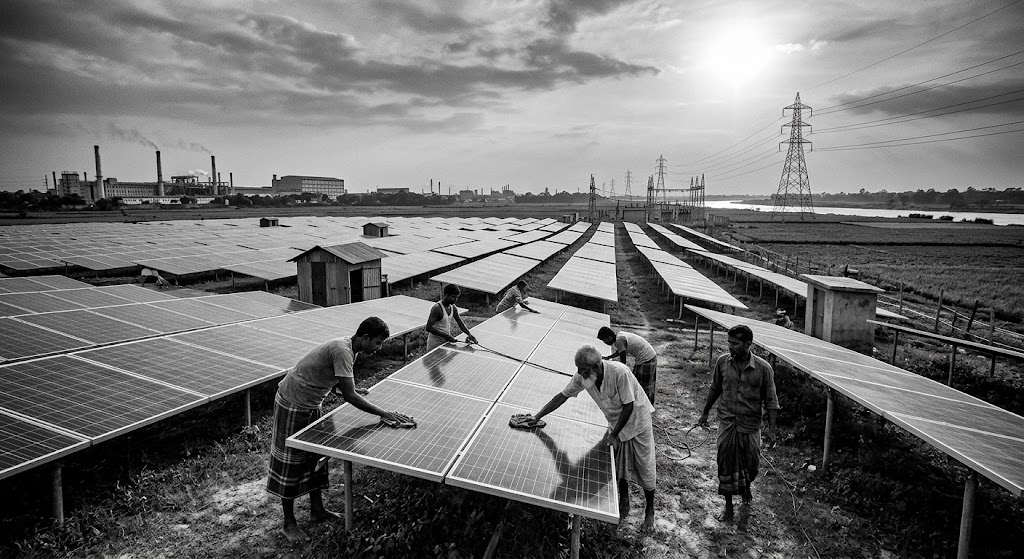
The garment sector grew on domestic gas, and gas shortages now push factories toward expensive diesel. Rooftop solar offers daytime electricity without recurring fuel purchases, and research suggests that suitably sized systems can recover their cost in five to eight years. Yet renewables supplied only about 3 percent of electricity in a study of 878 factories in Gazipur and Narayanganj, and smaller factories remain almost entirely dependent on conventional sources.
The Prime Minister’s emphasis on affordability and local manufacturing speaks directly to the barriers that matter most: cost, access and supply. Cleaner energy also protects export competitiveness, since international buyers increasingly favor suppliers with lower emissions.
Energy Security and Industrialization
Industrial growth depends on reliable and predictable power. A country that relies on imported fuel exposes its factories to price shocks and supply interruptions beyond its control. Solar is a domestic resource, and its cost has fallen sharply over the past decade. The push for local equipment production could create skilled jobs in manufacturing, installation and maintenance, strengthening industries well beyond garments. In this way the vision links energy policy with industrial policy, treating clean power as a foundation for competitiveness rather than a cost to be managed.
Comparison with SDG 7 and Related Goals
SDG 7 calls for affordable, reliable, sustainable and modern energy for all, including a substantial rise in the share of renewables. Bangladesh is still early on that journey, but the national direction now matches the goal. The initiative also supports SDG 9 on resilient infrastructure and sustainable industrialization, SDG 8 on decent work and economic growth, and SDG 13 on climate action. The Prime Minister’s insistence on affordability reflects the heart of SDG 7: access must reach everyone, not only large firms with spare capital.
Several complementary reforms would help turn the vision into widespread adoption.
Targeted financing. IDCOL’s planned programme, working through intermediaries with interest capped at 6 percent, is a promising foundation. It should be extended to small and medium-sized factories, with pooled applications, simpler documentation and repayment periods matched by savings.
Credit guarantees. Backing from the state or development lenders could make long term power purchase agreements and developer financed models bankable for smaller firms. International buyers could share risk through financing or firmer purchasing commitments.
Faster grid connection. One installer completed a 4.5-megawatt system in under three months, then waited two more months for net metering approval. A single window process with fixed timelines would let factories realize savings sooner.
Merchant power and wheeling. Transparent, low wheeling charges would allow factories to buy renewable electricity from plants elsewhere once roof space runs out. Trials of shared land use, such as solar panels above tea gardens, should be assessed carefully before expansion.
Technical support. Nearly half of the non-adopters in one survey cited a lack of expertise. Industry associations and technical institutes could certify installers, set equipment quality standards and offer advisory services to help owners compare suppliers.
Clear measurement. Success should be judged by how much fossil fueled electricity is displaced across factories of every size, reported publicly each year.
Conclusion
The Prime Minister’s solar initiative gives Bangladesh something its industrial sector has long needed: a clear national direction on clean, domestic and affordable power. Its emphasis on government leadership, local production and consumer affordability aligns closely with SDG 7 and supports wider goals for industry, employment and climate. With supplementary reforms in financing, guarantees, grid access and technical support, the vision can reach smaller factories as well as large groups, strengthening the garment industry and laying a durable foundation for the country’s industrial future.