
Mehran Sajjad
North South University
A comparative follow up to “Bangladesh’s Path to Sustainable Agricultural Transformation,” Oniket Bulletin, June 6, 2026
The original article makes a compelling case that Bangladesh’s next agricultural chapter depends on shifting from yield maximization toward sustainability and inclusivity, naming gender gaps in asset ownership, fragmented landholdings, and youth migration away from farming as the human capital weaknesses undermining that shift.
Placing Bangladesh alongside Malaysia, a country that industrialized its agricultural sector earlier and around a very different crop base, helps clarify what inclusive reform requires and where Bangladesh’s reform agenda still falls short. This article aims to initiate that discussion.
Two Starting Points
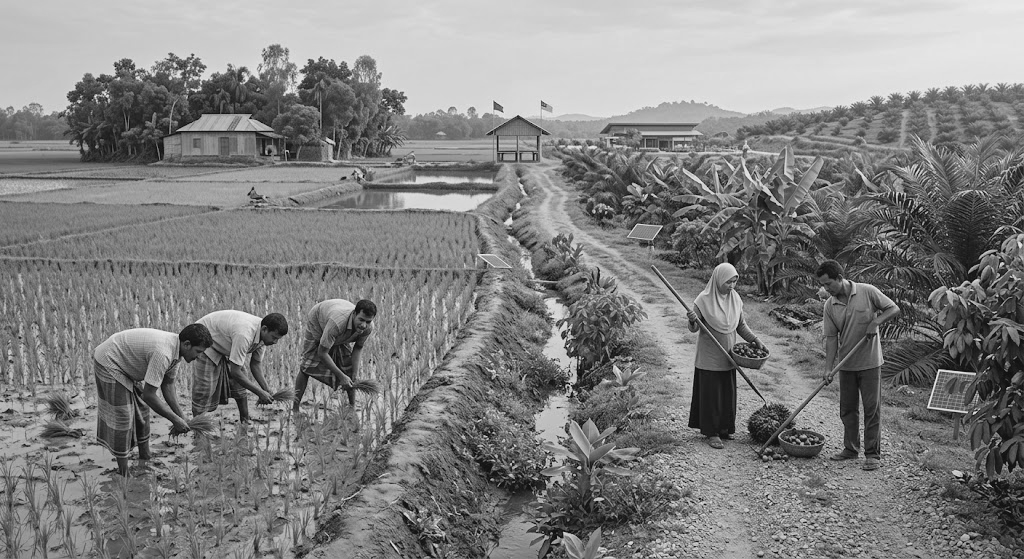
Bangladesh built its agricultural progress around smallholder rice farming intensified over time, a model that pushed the country to cereal self-sufficiency but left millions of farmers working small, scattered plots with little leverage in the market. Malaysia chartered a different course, consolidating land into large scale plantation systems, particularly for palm oil, and bringing smallholders into that system through schemes that provided resettled farming families with land, credit, and access to processing facilities.
Where Bangladesh’s approach treats fragmented land as a problem still to be solved, Malaysia’s experience shows that consolidating land brings its own inclusivity tradeoffs, since large scale plantation agriculture tends to concentrate economic gains in the hands of estate owners and bigger producers rather than smallholders and landless workers.
Gender and Asset Ownership
The Bangladesh article identifies persistent gender gaps in land, credit, and input access as a weakness that must be corrected through equal access policy. Malaysia faces a comparable challenge in a different form. Smallholder schemes there have often registered land titles under male household heads by default, leaving women with limited formal ownership even where they contribute substantial labor, particularly in smallholder oil palm and food crop production. In both countries, the underlying pattern is the same: agricultural growth has outpaced the legal and administrative reforms needed to make women equal stakeholders rather than uncounted contributors.
Youth, Migration, and Human Capital
Bangladesh’s youth are migrating away from farming toward urban and overseas work, echoing a trend Malaysia experienced a generation earlier as its own rural youth moved into manufacturing and services during its industrialization drive. Malaysia responded by mechanizing plantation agriculture and investing heavily in agribusiness education and vocational training tied to its export crops, which helped sustain productivity even as the farming population aged and shrank.
Bangladesh’s article proposes a similar response, expanding vocational training, agribusiness curricula, and digital skills for rural youth, but Malaysia’s experience suggests this only works when paired with genuine income opportunity in agriculture itself, not simply technical training layered onto a sector young people are already leaving.
Measuring Against the Sustainable Development Goals
Malaysia’s progress against the SDGs most relevant to agriculture, ending hunger, promoting sustainable production, and reducing inequality, reflects its middle-income status and earlier structural transformation, but has been complicated by heavy reliance on a single export crop and periodic international scrutiny over labor conditions and environmental impact tied to palm oil expansion.
Bangladesh sits earlier in its transformation, having secured food security gains that support SDG goals on hunger, but the original article is candid that inclusivity and environmental sustainability targets remain unmet, particularly around climate resilience, groundwater stress, and equitable access to credit and land. The comparison suggests Bangladesh is not simply behind Malaysia on a single timeline, but following a structurally different path where the risks of inclusivity failure look more like persistent smallholder poverty than plantation concentration.
Policy Reforms Bangladesh Should Prioritize
This comparison points toward several concrete reforms. As Bangladesh strengthens land tenure and enables voluntary leasing, as the original article proposes, these changes should explicitly require joint or women inclusive titling, closing the same gap that held back Malaysia’s smallholder schemes for decades before correction came. Vocational and agribusiness training for rural youth should be paired with visible income gains, through cooperative aggregation and processing investment, rather than offered as a standalone intervention, since training without real opportunity behind it only accelerates migration rather than slowing it.
Diversification beyond rice, already central to the original article’s agenda, should be pursued with deliberate care to avoid Malaysia’s overconcentration problem, so that growth in aquaculture, fruits, and high value crops reaches many smallholders instead of consolidating around a handful of large exporters.
Finally, Bangladesh’s plan for integrated multi stakeholder platforms spanning agriculture, health, water, and environment should build in a dedicated gender and youth inclusion metric within its SDG monitoring system, ensuring that productivity gains do not once again outpace progress on who benefits from them.
Conclusion
Bangladesh and Malaysia arrived at agricultural transformation from different starting points and along different crop pathways, but both illustrate the same underlying lesson: productivity gains and SDG compliance on paper do not automatically translate into inclusive outcomes for women, youth, and smallholders. Bangladesh’s reform agenda, as outlined in the original article, correctly names these gaps. Its success will depend on sequencing land, credit, and training reforms so inclusivity is built into agricultural growth from the outset, rather than added afterward once concentration and exclusion have already taken hold.
Reference: