
Desk Report
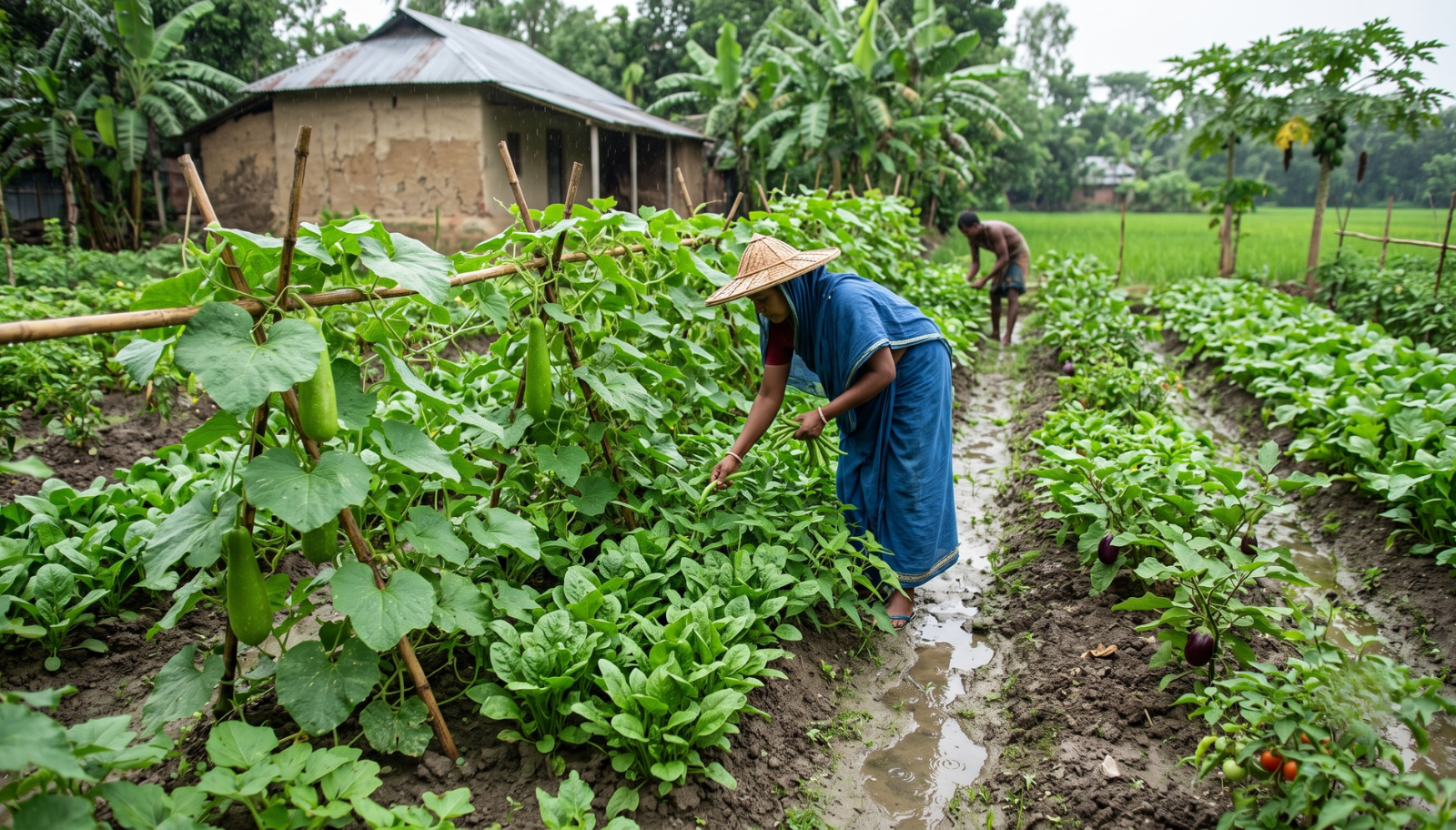
The monsoon season is vital to Bangladesh’s agricultural sector, but for vegetable farmers, it can also be a significant source of loss. From June to September, the country’s land surface is subject to inundation, with up to three-quarters of the land surface potentially affected. This has significant ramifications for vegetable production. Recent floods have destroyed over 986,000 metric tons of crops, and the World Bank estimates that Bangladesh loses roughly 800 million dollars worth of crops annually due to weather-related disruptions.
For a nation where vegetables are vital to both nutrition and rural livelihoods, the monsoon’s dual threat of excess water and supply chain disruption demands prompt policy action.
How the Monsoon Disrupts Vegetable Production
The most immediate damage is caused by flooding and waterlogging. When fields remain submerged for extended periods, standing vegetable crops are susceptible to root rot. Seedlings often perish before they can become established, and those that do survive frequently exhibit stunted growth or disease.
The heavy, unrelenting rain also leaches nutrients from the soil, reducing the productivity of land that is already under intense cultivation. Fungal and bacterial infections spread rapidly in the warm, wet conditions, further reducing yields. In severe flood years, up to 83 percent of crop producers report damage or total loss of their standing crops.
Beyond the fields, the monsoon disrupts the supply chain. Rural roads become impassable, cutting off farmers from wholesale markets. Trucks and vans are unable to access production zones, and the vegetables that are harvested are prone to spoilage during transport or at overcrowded wholesale terminals in cities like Dhaka. It is estimated that 30 to 40 percent of all perishable produce in Bangladesh is lost after harvest, with a significant portion of this loss occurring during the monsoon months. The absence of cold storage and refrigerated transport in this region contributes to the rapid deterioration of produce that reaches markets.
This results in a detrimental cycle. During the peak harvest season, which often coincides with the early monsoon, oversupply and spoilage lead to a situation where farmers are compelled to sell at significantly reduced prices. As floodwaters destroy subsequent plantings and stored stocks deplete, supply shrinks and prices soar, hitting low-income consumers hardest. This volatility persists annually with minimal improvement.
The Cold Storage Deficit
The core of this crisis is an evident infrastructural deficit. Bangladesh currently operates approximately 400 cold storage facilities, with over 90 percent dedicated exclusively to potatoes. Vegetables, which are far more perishable, have virtually no dedicated cold chain infrastructure.
According to expert assessments, the country requires at least 1,000 modern, multi-commodity cold storage units to meet current national demand. The existing facilities are concentrated near urban centers, with minimal presence in major vegetable-producing regions such as Jamalpur, Rangpur, and Jashore. Refrigerated transport is practically nonexistent, and grading and packaging centers near production zones are rare. Absent this infrastructure, post-harvest losses will persist, irrespective of any increase in production.
Adaptation Strategies That Work
Bangladesh has its own unique expertise in this area, which can help mitigate the impact of the monsoon season. Floating agriculture, known locally as dhap, is a technique with a history of over 300 years. Farmers build rafts from water hyacinth and sow vegetable seedlings directly onto them. These floating gardens enable cultivation in areas subject to flooding for up to eight months a year, producing okra, cucumber, tomatoes, gourds, and amaranth.
The United Nations Food and Agriculture Organization has formally acknowledged this system as one of its 34 Globally Important Agricultural Heritage Systems. Research indicates that floating gardens can provide approximately 40 percent more arable land in waterlogged districts. In 2013, the government allocated $1.6 million to DHP pilot programs, providing assistance to 12,000 families across eight districts. However, the scale of these initiatives remains significantly below the required level.
The development of flood-tolerant and short-duration vegetable varieties is another proven pathway. Research institutions in Bangladesh have made significant progress with stress-tolerant crop varieties and fast-growing vegetables. These vegetables can be harvested before floodwaters arrive or planted immediately after they recede, thus significantly narrowing the lean season supply gap. However, the dissemination of these varieties to smallholder farmers remains uneven, and the seed supply chain itself is vulnerable to monsoon disruptions.
Essential Policy Reforms
The first and most pressing reform is to treat cold storage as essential national infrastructure, on par with roads and electricity. The government must lead a public private partnership model that provides the bulk of capital investment for multi commodity cold storage facilities, with targeted subsidies and concessional financing to de-risk the sector for private operators. India’s experience offers a useful template, where government subsidies of up to 50 percent for cold storage development under the Mission for Integrated Development of Horticulture have produced measurable reductions in post harvest loss.
Second, cold storage construction must be geographically targeted to vegetable producing districts, not just urban market zones. Each facility should be integrated with grading, packaging, and refrigerated transport services to form a complete cold chain from farm to consumer. Thailand’s model of cooperative run cold storage units supported by state backed credit and training programmes could be adapted to the Bangladeshi context.
Third, floating agriculture and other indigenous adaptation techniques must be scaled up through dedicated funding, training, and integration into mainstream agricultural extension services. The current pilot scale is insufficient given the scale of annual flooding.
Fourth, the development and distribution of flood tolerant and short duration vegetable seeds requires a coordinated push from agricultural research institutions, with incentives for private seed companies to multiply and market these varieties. Seed storage infrastructure itself must be protected from monsoon damage.
Fifth, climate information services must be made accessible to farmers at the local level. National adaptation policies exist on paper but consistently fail to reach the villages where they matter most. Last mile delivery of weather forecasts, flood warnings, and crop advisory services through mobile platforms and community networks can help farmers plan planting and harvesting around monsoon patterns.
Sixth, existing policy frameworks such as the Delta Plan 2100 and the Agriculture Modernisation Plan must explicitly prioritise cold chain development and post harvest loss reduction, with clear timelines and budget allocations. The ministries of Agriculture, Commerce, and Industries must coordinate an integrated strategy rather than working in isolation.
The monsoon will not change. What must change is Bangladesh’s readiness for it. Building a resilient, cold chain enabled vegetable supply system is the only credible path to year round food security, stable prices, and rural prosperity in a country that will only face more extreme weather in the decades ahead.