
Mio Okalinde
Universiti Malaya
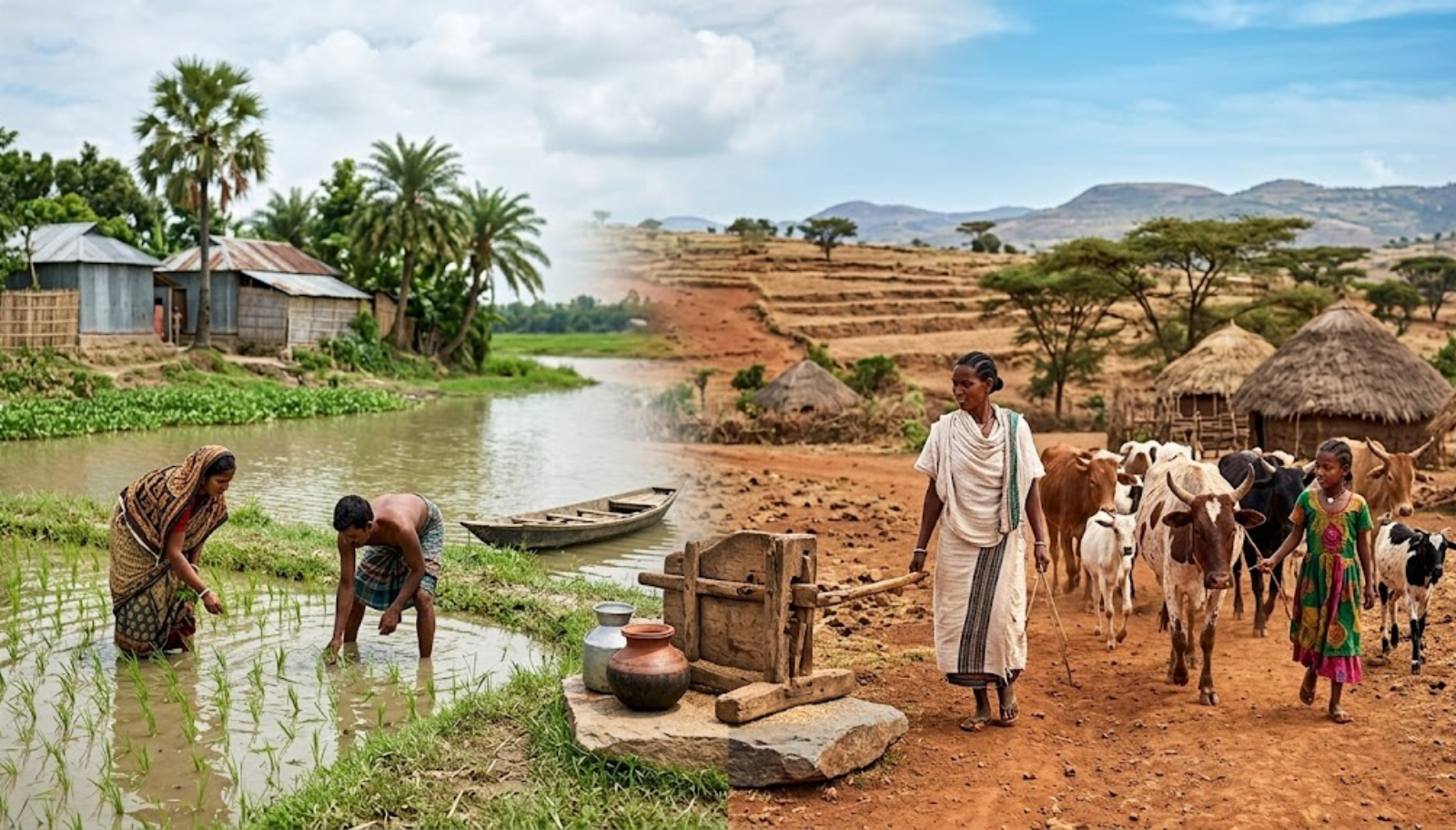
Bangladesh and Ethiopia are often cited together in development literature as two of the more instructive cases in recent decades, countries that achieved meaningful poverty reduction through periods of sustained growth, only to see that progress slow or reverse under the weight of external shocks and structural weaknesses. Drawing on recent World Bank assessments, this analysis compares how agricultural growth and governance quality have shaped poverty trajectories and rural development outcomes in each country.
Bangladesh: A Slowing Success Story
Bangladesh’s poverty reduction record between 2010 and 2022 remains one of the more notable achievements in global development. According to the World Bank’s Bangladesh Poverty and Equity Assessment, extreme poverty fell from about 12.2 percent to 5.6 percent over that period, while moderate poverty dropped from roughly 37.1 percent to 18.7 percent, lifting around 25 million people out of poverty overall. Rural areas led much of this progress, aided by a rebound in agricultural output, and between 2016 and 2022 poverty declined faster in rural regions than in urban ones.
However, the World Bank’s more recent monitoring shows this momentum has reversed. National poverty is estimated to have climbed from 18.7 percent in 2022 to over 21 percent by 2025, with roughly 36 million people now classified as poor. The Bank attributes this reversal to weak job creation, persistent inflation, and a labor market where a large share of new employment, around 63 percent by recent estimates, has been concentrated in low-income agricultural work rather than higher productivity sectors. Around 62 million people, roughly a third of the population, remain vulnerable to slipping back into poverty from a single shock such as illness, a natural disaster, or a price spike.
Governance factors compound these economic pressures. Bangladesh continues to rank poorly on corruption indices, and institutional capacity to translate GDP growth into broad based welfare gains has weakened since 2016, according to World Bank analysis, with income growth increasingly favoring wealthier households over the poorest ones. Agriculture still accounts for a meaningful share of GDP and employment, but its capacity to absorb new workers productively appears to be reaching its limits, pushing the country toward a more urgent need for diversification into higher wage industrial and service sector jobs.
Ethiopia: A Sharper Reversal
Ethiopia’s trajectory shows a steeper and more dramatic reversal. Between 2000 and 2015, the country was frequently held up as an African development success story, with strong agricultural growth and heavy infrastructure investment driving substantial poverty reduction. That progress has since eroded sharply. World Bank data measured at the three dollar a day poverty line show poverty rising from about 33 percent in 2016 to 39 percent by 2021, with projections placing the rate as high as 43 percent by 2025.
The drivers behind this reversal are largely a mix of conflict, climate shocks, and macroeconomic instability. The Tigray conflict displaced roughly 3 million people and generated an estimated 20 billion dollars in humanitarian and reconstruction needs. Recurrent droughts have hit rural livelihoods hard, and roughly 15 million Ethiopians remain dependent on food aid. Because close to three quarters of Ethiopia’s population lives in rural areas, and around 70 percent of the workforce still depends on agriculture, these shocks have disproportionately affected rural households, a pattern the World Bank describes as an intensification of the rural character of Ethiopian poverty.
Human capital deficits further constrain rural development prospects. As of 2021, roughly 86 percent of rural adults had not completed primary education, nearly half of rural households had at least one stunted child, and access to basic infrastructure such as electricity and sanitation remained three to four times more common among the wealthiest fifth of the population than the poorest fifth. Governance challenges have added further strain, most notably Ethiopia’s 2023 sovereign debt default and a subsequent joint World Bank and IMF assessment in 2025 declaring the country’s external debt unsustainable, a designation that constrains the government’s fiscal space for rural investment and safety net programs.
Comparing Agricultural Growth and Governance
Both countries illustrate how agriculture led growth can drive substantial early-stage poverty reduction, but also how fragile such gains can be without accompanying structural transformation. Bangladesh’s agricultural rebound after 2016 helped rural poverty fall faster than urban poverty, yet the World Bank notes that much of the resulting employment has been low productivity in nature, limiting how far continued agricultural expansion alone can push poverty reduction forward. Ethiopia’s earlier agricultural growth phase similarly failed to generate enough productivity gains or job creation to absorb the roughly 1.8 million new job seekers entering its labor market each year, according to World Bank assessments, leaving the economy vulnerable once external shocks arrived.
Governance differentiates the two cases somewhat. Bangladesh, despite weak anti-corruption performance and slowing inclusive growth, has maintained relative macroeconomic stability and avoided sovereign default, giving it more policy space to address its poverty reversal through job creation and social protection reform. Ethiopia’s governance challenges have been compounded by internal conflict and a formal debt default, which together have narrowed the fiscal room available for rural investment precisely when rural poverty has been intensifying.
Conclusion
The comparative picture that emerges from World Bank data is one of two countries whose early development gains proved less durable than hoped. Bangladesh’s slowdown reflects a maturing economy struggling to move beyond low productivity agricultural employment and address widening inequality, while Ethiopia’s reversal reflects a more acute combination of conflict, climate vulnerability, and fiscal crisis layered on top of already fragile rural human capital. For both nations, sustained rural poverty reduction will likely depend less on agricultural growth in isolation and more on governance reforms that improve market access, human capital investment, and fiscal resilience against future shocks.