
Farah Zahir
Editor, Oniket Research Group
Modhu Mash, the month of honey has arrived, and as the scorching heat of June and July settle over the delta, the first thing that comes to our mind is the irresistible aroma of ripe mangoes. It is a sensory celebration deeply woven into the cultural fabric of Bangladesh. While our local markets overflow with sweetness, a bitter reality confronts us on the global stage. Bangladesh is an agricultural heavyweight, proudly ranking as the seventh-largest mango producer in the world with an annual output exceeding 2.4 million metric tons. However, when it comes to the international market, our presence is nearly invisible; in 2025, the country managed to export a meager 2,194 metric tons, representing a minuscule 0.1 percent share of the global mango trade. This staggering disparity highlights a profound failure of policy, infrastructure, and strategic execution for a resource that could yield massive foreign exchange and successfully diversify our export basket away from its dangerous over-reliance on ready-made garments.
The Global Export Chasm: How Regional Competitors Outpace the Delta
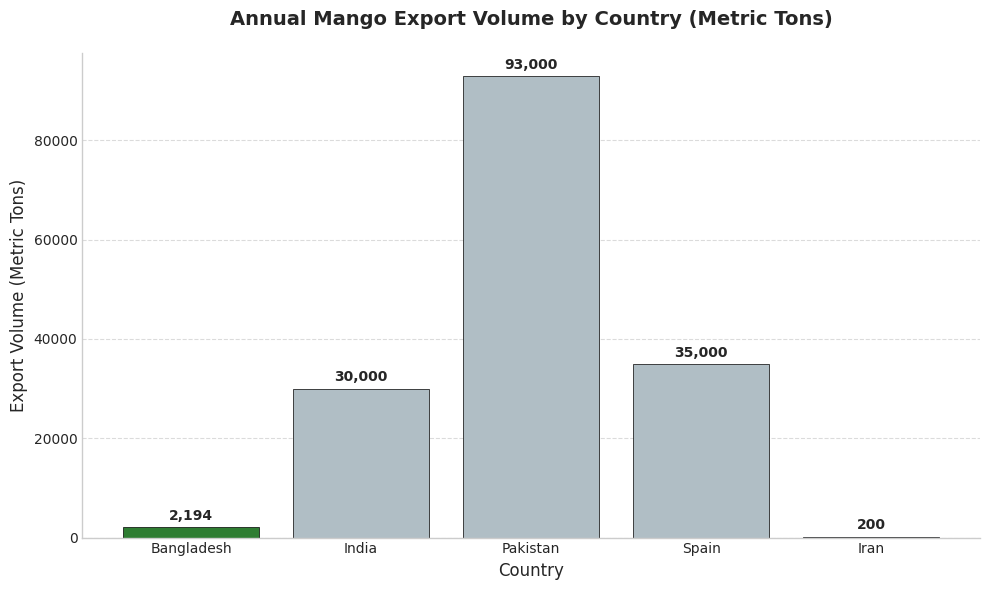
A closer look at the international landscape highlights just how severely Bangladesh is being outpaced by its regional and global competitors. As illustrated in the annual export data from the graph (BSS), Pakistan dominates the regional landscape by exporting 93,000 metric tons valued at $61 million, while Spain has shipped approximately 35,000 metric tons to capture a premium $100 million market in Europe, and India consistently hits the market with roughly 30,000 metric tons. Even smaller players like Iran maintain niche channels of 200 metric tons across West Asia. In stark contrast, Bangladesh’s massive Tk 7,000 crore domestic mango trade remains almost entirely insular. While our premium varieties have found a loyal following among South Asian diaspora communities, with 2025 shipments seeing 686 tonnes go to the United Kingdom, 356 tonnes to Saudi Arabia, and 264 tonnes to Italy, we have fundamentally failed to break into high-value mainstream global supermarkets, largely due to an institutional void and a dangerous export monoculture where a single variety, Amrapali, accounts for 80 percent of all shipments.
Decoding the Bottlenecks: Structural Deficits and Logistical Disadvantages
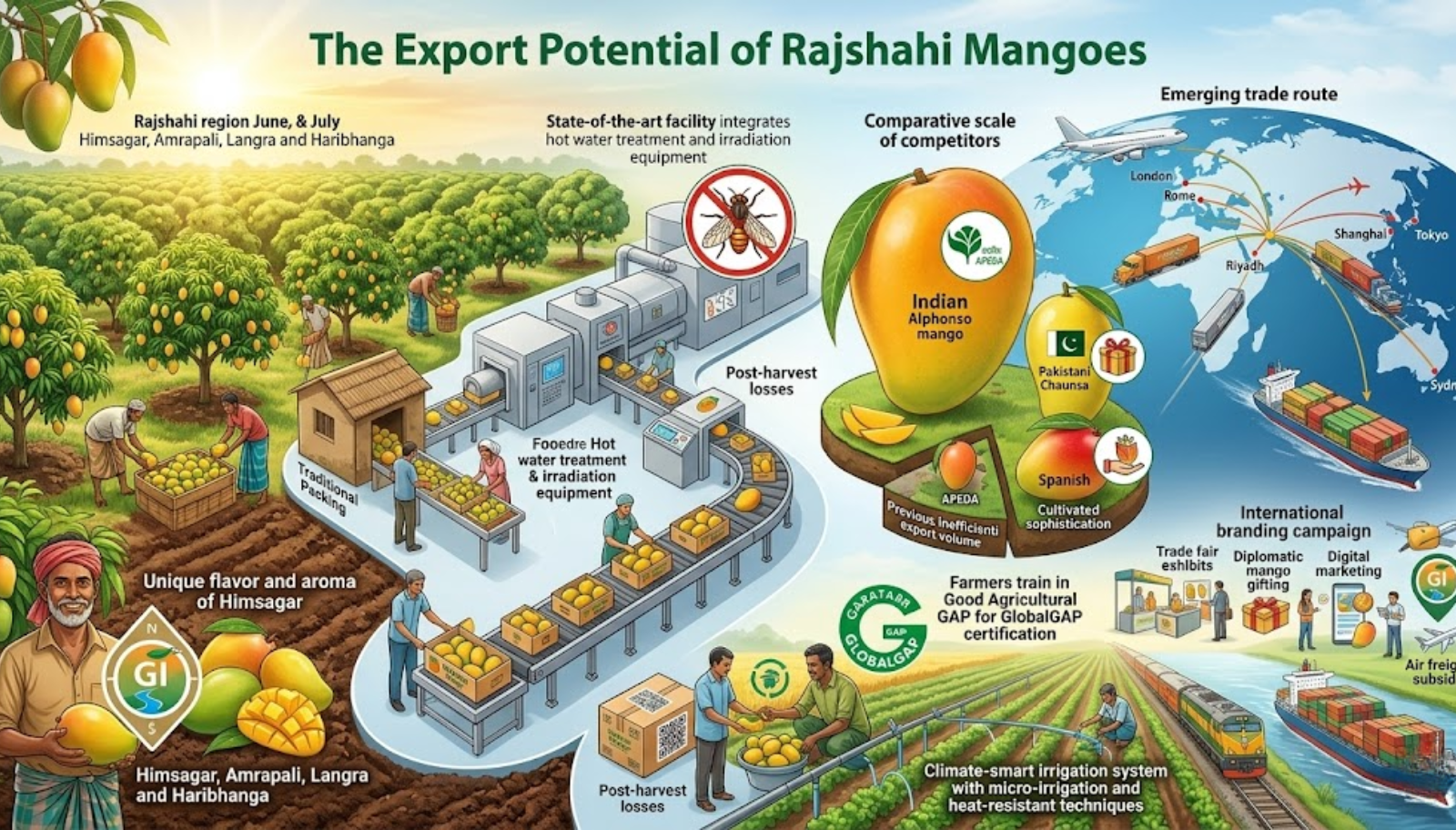
The root of this export failure lies in deep structural and phytosanitary bottlenecks that commercial policy has yet to resolve. High-value markets like the European Union, United States, and Japan enforce strict zero-tolerance policies for fruit flies and chemical residues, yet Bangladesh completely lacks commercial-scale Vapour Heat Treatment (VHT) and irradiation facilities near the primary production zones of Rajshahi and Chapainawabganj. This deficit is compounded by a catastrophic supply chain that suffers 25 to 30 percent post-harvest losses due to primitive handling, poor packaging, and a complete lack of localized cold chain infrastructure. To make matters worse, air freight charges out of Dhaka are two to three times higher than those available to exporters in India or Pakistan, effectively destroying any natural price advantage that the unmatched sweetness of our Barind tract soil imparts to premium varieties like Himsagar, Langra, and Haribhanga.
A Blueprint for Reform: Building a Framework of Compliance and Modern Infrastructure
Overcoming these barriers requires shifting from isolated, short-term projects to a legally backed, centralized governance agenda. The government must establish a unified Bangladesh Agricultural Export Development Authority (BAEDA), modeled after India’s successful APEDA, to serve as a single-window platform for streamlining certifications, logistics, and export incentives. Simultaneously, the mandate and budget of the current Tk 47 crore Exportable Mango Production Project must be significantly expanded to deploy localized VHT plants and solar-powered cold hubs through Public-Private Partnerships (PPPs). On the field level, a national campaign must be funded to bring at least 5,000 farmers under GlobalGAP compliance within five years, supported by an orchard-to-port e-traceability system to satisfy Western transparency demands. Furthermore, negotiating seasonal cargo agreements with airlines to lower freight costs, diversifying the export basket beyond Amrapali, and introducing climate-smart agricultural practices to counter recent 40 percent yield drops caused by heatwaves are critical steps to stabilize global supply.
The Path Forward: Executing Mango Diplomacy and Strategic Global Branding
Ultimately, the chasm between Rajshahi’s golden harvest and our negligible global market share is a failure of policy, not nature. Bangladesh must transition away from relying on passive demand from expatriates and instead execute an aggressive, state-led international branding campaign. By integrating “mango diplomacy” through our foreign embassies, including targeted diplomatic gifting of GI-tagged Khirshapat shipments to global state leaders and head corporate buyers, and actively participating in premier global food expos, we can build a premium brand identity mirroring the success of Spain’s Andalusian or India’s Alphonso mangoes. With targeted regulatory reforms, infrastructure deployment, and strategic marketing, Rajshahi’s mangoes can finally claim their rightful place on the world stage, transforming a beloved domestic treasure into a premier global export powerhouse.

