
Naima Onamika
Commissioning Editor, The Oniket Bulletin
Madrasa education remains a vital component of Bangladesh’s education system. Hundreds of thousands of students, particularly from lower income and lower middle-income families, receive their education through Alia and Qawmi madrasas. For decades, these institutions have played an important role in promoting religious education, nurturing moral values, and providing educational opportunities to communities that might otherwise have limited access to formal schooling.
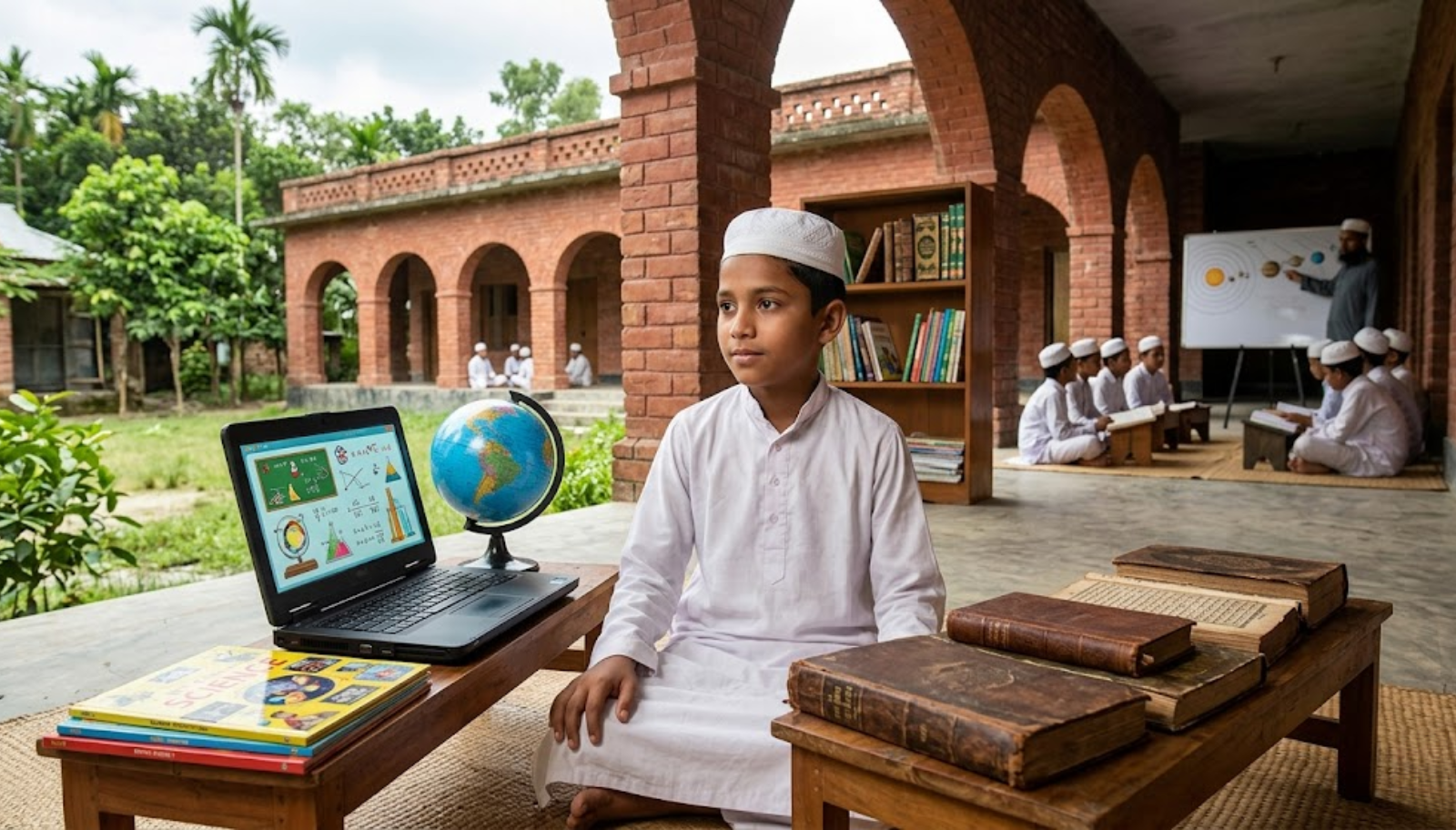
However, the realities of the twenty-first century have created new challenges. Globalisation, rapid technological advancement, and changing demands in the labour market require educational institutions to equip students with a broader range of knowledge and skills. As a result, preserving religious heritage while preparing students for the modern world has become one of the most pressing challenges facing Madrasa education today.
A Dual System with Unequal Outcomes
Madrasa education in Bangladesh operates through two main streams: Alia and Qawmi. Alia Madrasas functions under the government’s Madrasa Education Board and combines religious studies with a range of general education subjects. Qawmi madrasas, by contrast, are largely independent institutions funded through donations and, in some cases, student fees. Their curriculum continues to rely heavily on the traditional Dars e Nizami syllabus developed centuries ago.
This dual structure has created significant disparities in educational outcomes. While Alia students receive some exposure to modern subjects, many Qawmi students have limited opportunities to study science, mathematics, information technology, and English. As a result, many find themselves at a disadvantage when pursuing higher education or competing in the modern job market. Addressing this gap does not require abandoning religious education. Rather, it requires thoughtful reforms that allow students to benefit from both religious and contemporary knowledge.
The Need for Curriculum Modernisation
Curriculum reform is perhaps the most urgent priority. In today’s world, students need access not only to religious studies but also to science, mathematics, information technology, social sciences, civic education, and English language skills. These subjects are essential for participation in modern society and the global economy. The objective of reform should not be to replace religious education. Instead, it should aim to create a meaningful balance between religious learning and contemporary knowledge. Such an approach would enable students to develop a strong understanding of Islamic teachings while also gaining the skills needed to navigate modern social, economic, and professional realities.
Investing in Teacher Development
No education system can succeed without qualified and motivated teachers. Although many madrasa teachers are deeply committed to their profession, teaching methods in some institutions still rely heavily on memorisation and rote learning. This often limits opportunities for students to develop critical thinking, creativity, and problem-solving skills.
Comprehensive teacher training programmes are therefore essential. Educators should receive regular training in modern teaching methods, classroom management, educational technology, and updated subject knowledge. At the same time, improving salaries, professional benefits, and career development opportunities would help attract and retain talented educators within the madrasa system.
Expanding Vocational and Technical Education
Each year, thousands of Madrasa graduates enter the workforce. However, many possess limited professional skills beyond their religious education. Introducing vocational and technical training could significantly improve employment opportunities for these students. Programmes in information technology, entrepreneurship, healthcare, agriculture, electronics, tailoring, and other practical fields would provide valuable skills for both employment and self-employment.
Several Muslim majority countries, including Indonesia and Malaysia, have successfully integrated religious education with vocational and technical training. Their experience demonstrates that students can remain grounded in religious values while also acquiring skills that contribute to economic development.
Strengthening Accountability and Quality Standards
The issue of quality assurance, particularly within the Qawmi madrasa sector, has long been part of the national discussion on education reform. While the independence and distinct character of religious institutions should be respected, the state also has a responsibility to ensure that every student receives a minimum standard of education.
A practical solution would be to develop a regulatory framework through consultation with Qawmi scholars, educators, parents, and other stakeholders. Such a framework could establish basic standards for curriculum quality, teacher qualifications, student welfare, and institutional infrastructure. Importantly, these standards should enhance educational quality without undermining the religious identity or core mission of madrasa education.
Promoting Equal Opportunities
At its core, Madrasa reform is a matter of social justice and equal opportunity. Every student, regardless of the educational institution they attend, should have access to similar opportunities for higher education, employment, and social mobility. A modernised Madrasa system can help create graduates who are firmly rooted in their religious values while also possessing the knowledge and skills needed to thrive in a rapidly changing world.
For this reason, Madrasa reform should not be viewed as a challenge to religious identity. Rather, it should be understood as an investment in human capital, national development, and the future success of Bangladesh’s youth.
Conclusion
The reform of madrasa education in Bangladesh is no longer simply a matter of policy debate. It has become an important requirement for the country’s long-term development. By carefully balancing religious heritage with modern education, Bangladesh can build a system that is relevant, inclusive, and responsive to contemporary needs. Achieving this goal will require a collaborative and sensitive approach that respects the concerns of religious communities while embracing the opportunities of educational reform.
If implemented thoughtfully, such reforms can empower future generations, strengthen social progress, and contribute significantly to the nation’s economic and educational advancement.