
Desk Report
Oniket Desk Report
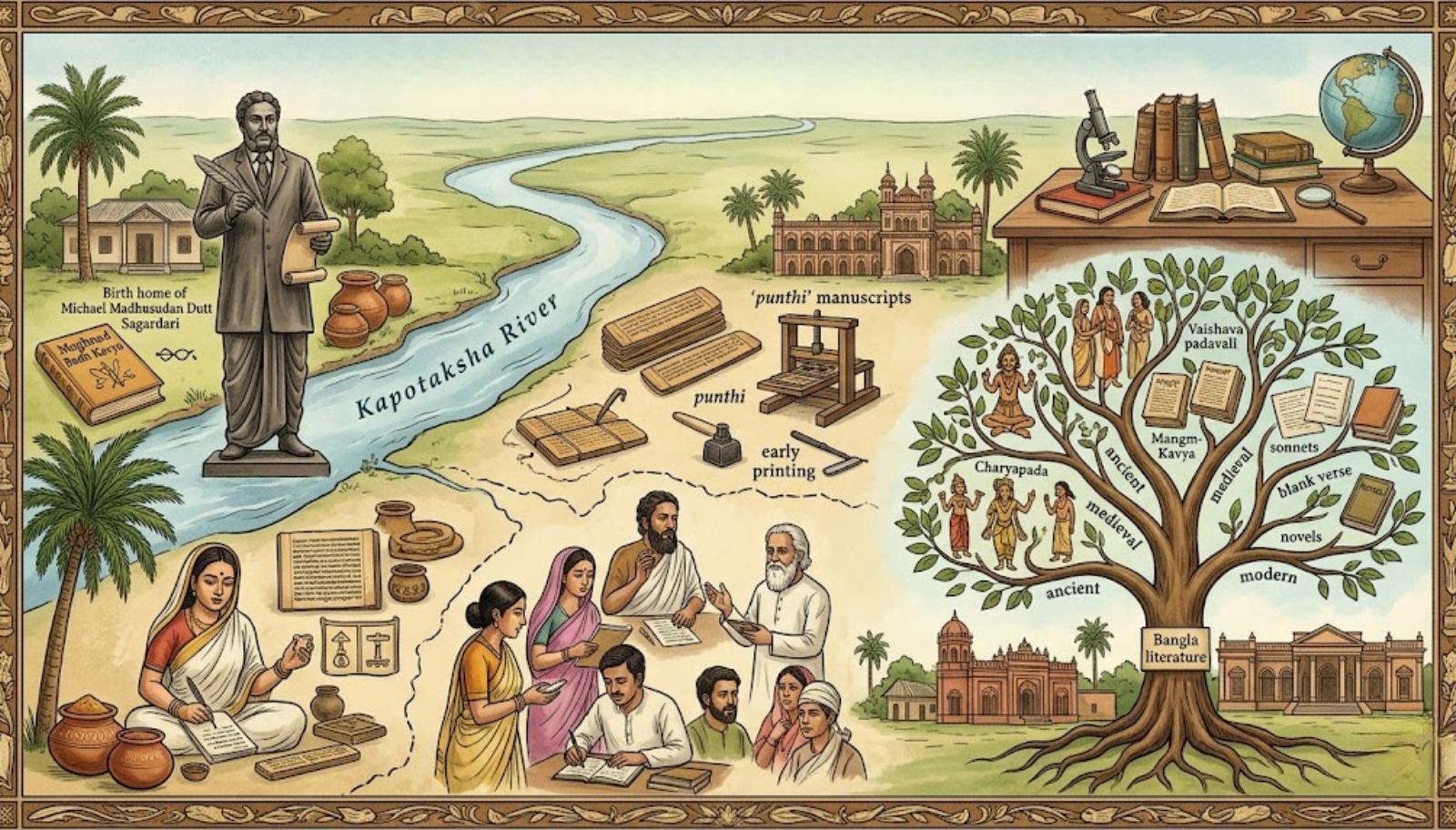
On the map of Bangla literature, Jessore holds a uniquely distinguished and glorious position. This district has enriched the intellectual landscape of Bangladesh for centuries not only through agriculture and trade, but also through literature and culture. It is the birthplace of Michael Madhusudan Dutt, celebrated as the father of modern Bangla literature. This single fact alone makes the literary significance of Jessore unparalleled. Over the past hundred years, the literary tradition of Jessore has advanced, expanded, and radiated new light upon this rich heritage.
The Nineteenth-Century Foundation and Michael’s Legacy
Michael Madhusudan Dutt was born in 1824 in the village of Sagardari in Jessore. He introduced blank verse into Bangla literature and remains eternally remembered as the pioneer of the Bangla sonnet. His epic works Meghnad Badh Kavya and Birangana ushered Bangla literature into a new era. Michael’s blazing legacy became the source of inspiration for later generations of writers and poets from Jessore. At the beginning of the twentieth century, literary practice in Jessore moved forward while carrying this inheritance.
The First Half of the Twentieth Century: Growth of Institutions and Talent
At the beginning of the twentieth century, an organized literary movement gradually emerged in Jessore. Jessore Institute, literary associations, and various reading circles became the centers of this cultural awakening. During this period, several literary magazines began to be published from Jessore, providing local poets and writers with opportunities to showcase their work. The Swadeshi movement and later anti-British nationalist consciousness deeply influenced the literature of the region, and themes of patriotism, the desire for liberation, and the realities of rural life began to appear in poetry and prose.
During this phase, poet Kader Nawaz Khan emerged as a prominent figure in the literary sphere of Jessore. His poetry reflected an extraordinary fusion of Islamic heritage and humanistic thought. His poem Kobor (“The Grave”) earned a permanent place in the hearts of readers as an immortal creation in Bangla literature.
Partition, Famine, and a New Dimension in Literature
The Great Bangla Famine of 1943 and the Partition of 1947 fundamentally transformed the social and cultural life of Bengal. Jessore, too, could not escape these historical tragedies. Their sorrowful impact was reflected in the literature of the region. Novelist Abu Ishaque, born in the village of Kenukata in Jessore, published his immortal novel Surja Dighal Bari in 1955. Written against the backdrop of the famine of 1943, the novel became a milestone in Bangla fiction. Very few writers have portrayed so powerfully the suffering of impoverished rural people, their struggle for survival, and the cruelty of patriarchal society. Later, the novel was adapted into a film, which became an important chapter in the cultural history of Bangladesh.
Literary Echoes of the Language Movement and the Liberation War
The Language Movement of 1952 inspired a new wave of creativity among the poets and writers of Jessore. The struggle to preserve the dignity of the mother tongue found expression through poetry, short stories, and essays. The Liberation War of 1971 left an even deeper imprint on the literature of Jessore. Jessore was one of the first liberated districts during the war. This historic experience added a special emotion and depth to the writings of local authors. Numerous poems and literary works centered on the memories of the Liberation War, the sacrifices of martyrs, and the joy and pain of independence emerged from Jessore during this period.
The Post-Liberation Era and Contemporary Literature
In the decades following independence, both the scope and diversity of literary activities in Jessore expanded significantly. Through literary organizations, literary journals, and book fairs, a new generation of writers found opportunities to express themselves. Writers from Jessore remained active in every branch of literature, including poetry, novels, short stories, and essays. Themes such as women’s rights, social inequality, the impact of urbanization, and crises of identity gained particular prominence during this phase.
During this period, literary practice also spread across different upazilas of Jessore. The local language and elements of folk literature from regions such as Maheshpur, Keshabpur, Sharsha, and Chaugachha blended into modern literature, creating a distinct regional character. The heritage of Bhatiyali and folk songs gave this literature a deeply rooted vitality connected to the soil.
The hundred-year journey of Bangla literature in Jessore is, in reality, a grand convergence of many voices, from the revolutionary genius of Michael Madhusudan Dutt to the humanistic prose of Abu Ishaque, from the fervor of the Language Movement and the Liberation War to the experimental verses of today’s young poets. The roots of this literary tradition run deep, while its branches extend far and wide. The responsibility of this generation lies in thoroughly researching, preserving, and promoting this rich literary heritage so that it may be established even more firmly within the mainstream of Bangla literature.
Keep reading… Shaping the Future from Clay: Reviving Bangladesh’s Rural Craft Heritage Through Policy and Pride
Jahanara Imam– A Unique Vision of Life, Literature and Patriotism