
Nowshin Zinat
BRAC University
Has the relentless stream of bulletins on Bangladesh’s news channels warped both the news and the way the public understands facts? To find out, the discussion sets today’s nonstop coverage against the fixed bulletins of the BTV era, assesses the damage caused by repetition and distortion, and examines how the Ministry of Information and the legal framework might help rebuild credibility.
The Era of the Eight and the Ten
For a generation, the nation’s news rhythm was set by BTV’s bulletins at eight and ten in the evening. Families gathered, the newsreader appeared, and the day’s events were presented in a measured sequence. The format had its faults. It was state owned, often deferential to authority, and silent on what governments preferred unsaid.
Yet it also had virtues that are easy to overlook. Stories passed through editors before they reached the screen, facts were checked against sources, language was carefully chosen, and a limited number of slots forced editors to decide what truly mattered. Scarcity imposed discipline. A viewer who watched one bulletin could trust that what he saw had been weighed.
The Arrival of the Endless Bulletin
Private satellite channels, and later online platforms, transformed that landscape. Bangladesh now has numerous television news operations, each filling hours of airtime with hourly bulletins, headline loops, scrolling tickers and breaking news banners. Competition has brought gains: wider coverage, more voices, faster reporting and a public that can no longer be easily kept in the dark. But the same competition has created a hunger that facts alone cannot feed.
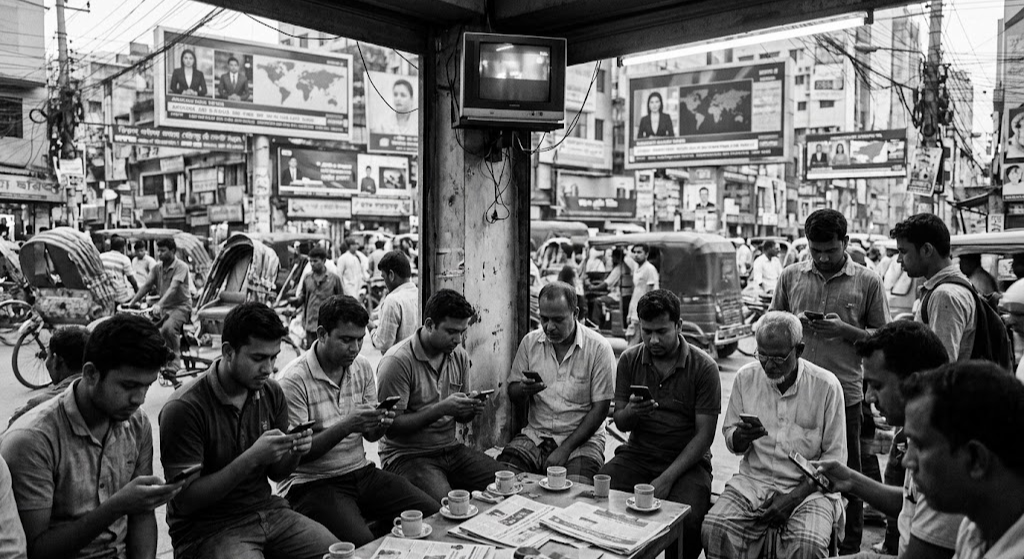
When airtime must be filled every hour, the same story is replayed with new graphics and louder presenters. A single press conference, accident or political remark can dominate a day, repeated until it appears larger than it is. Repetition has a psychological effect: viewers come to believe what they hear often, and to think that what is shown often is what matters most. Meanwhile slower but vital subjects, such as public health, local government budgets, education quality and climate adaptation, struggle for attention because they do not generate dramatic footage.
Speed Against Accuracy
The race to be first erodes verification. Rumors circulate as breaking news, casualty figures change from bulletin to bulletin, and unverified claims are broadcast with the caveat tucked away or never corrected. Talk shows reward confrontation over information, with panelists asserting claims that go unchallenged. Sensational headlines and background music turn reporting into entertainment. Retractions, when they come, rarely get the prominence of the original error. Public perception then rests on impressions formed in haste, and trust in the media falls, driving audiences toward social media rumors, which is faster still and less accountable.
Commercial pressure compounds the problem. Ratings and advertising reward emotion, and ownership ties to business or political interests can shape which stories are amplified and which are buried. Distortion does not always require outright falsehood. Selective emphasis, omitted context and repeated framing can mislead as effectively as a lie.
The Role of Law and the Ministry of Information
The Ministry of Information wields real influence through licensing, policy and oversight of state media, yet its challenge is to protect the public interest without becoming a censor. Past pressure on critical outlets and favor for friendly ones has left trust low. A better role is neutral enabler: transparent licensing, clear standards, training support, and state media that models accuracy and balance rather than propaganda. Reviving independent public service broadcasting, in the spirit of the old bulletins, would give audiences a trusted benchmark.
The constitution guarantees freedom of speech and the press, subject to reasonable restrictions, and the country has a Right to Information Act, a Press Council and a national broadcast policy. Yet the framework is fragmented. Overlapping rules on broadcasting, online content and defamation invite selective enforcement, and criminal provisions risk silencing reporting rather than punishing genuine falsehood.
Reform must therefore protect journalists from arbitrary arrest while strengthening accountability through an independent statutory broadcasting commission, with clear rules on corrections, right of reply, advertising separation and ownership disclosure. Editor-led self-regulation, public complaint mechanisms and regular audits would complement the law.
Conclusion
Nostalgia for the eight o’clock news should not become a demand for state control. The old bulletins were disciplined but often too obedient. The lesson is not to restore silence but to restore standards. A media environment can be abundant and trustworthy at once, if editors resist the tyranny of the clock, if regulators act with independence and transparency, and if the law shields honest journalism while holding falsehood to account. Frequency is not the enemy. Carelessness is.