
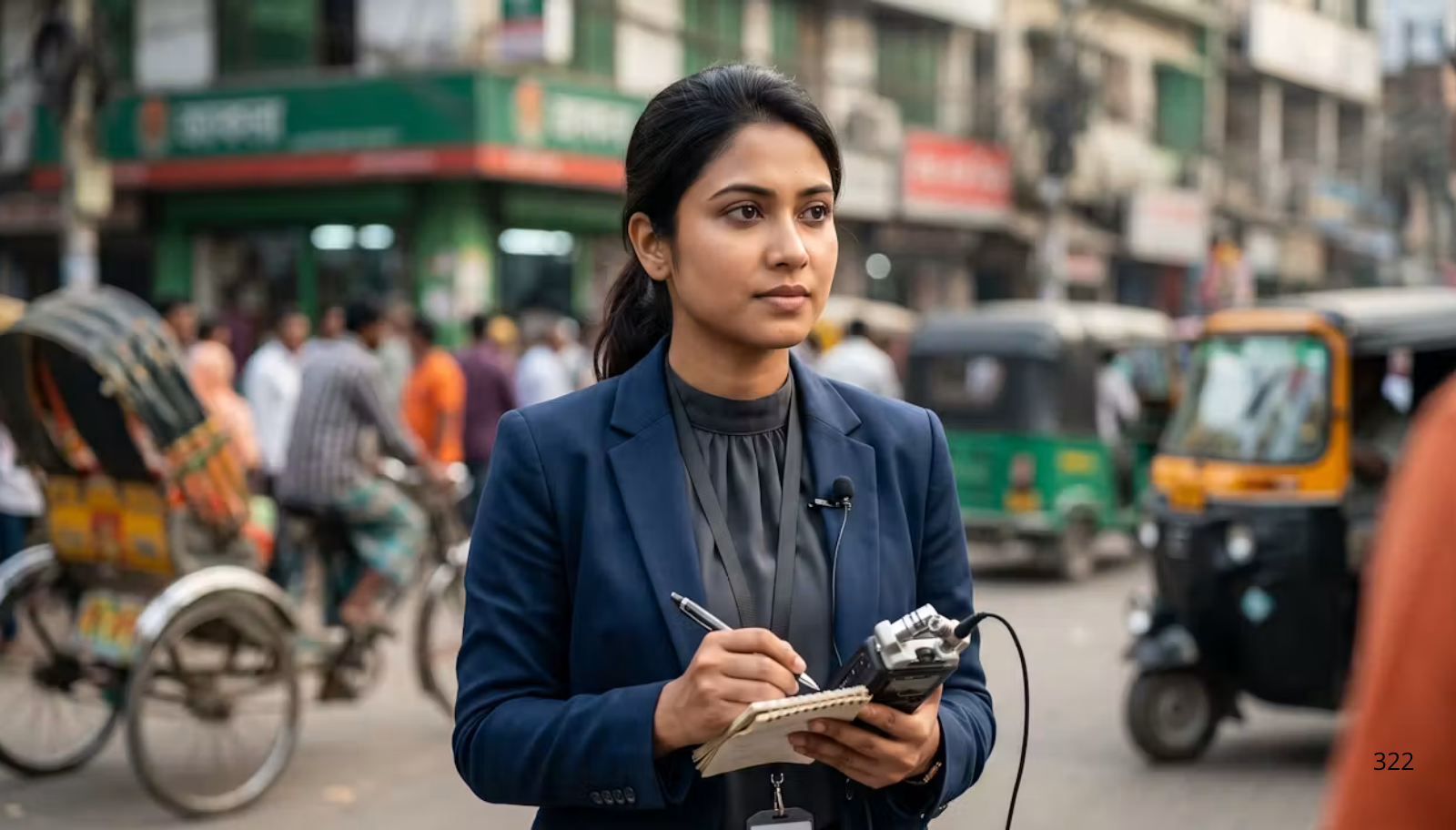
Farah Zahir
Managing Editor, Oniket Bulletin
Ask a young graduate in Dhaka why they entered journalism, and the answer rarely mentions salary security or career prestige. It is almost always framed as calling, a desire to speak truth to power, to give voice to the voiceless. That framing captures something real about Bangladeshi journalism, but it also conceals an uncomfortable truth: the profession has never fully matured into the disciplined, ethically anchored institution that a functioning democracy requires. Whether journalism in Bangladesh is a smart, deliberately chosen profession or simply a field sustained by personal passion depends largely on how one weighs its scale against its ethical fragility.
On paper, the industry looks formidable. Bangladesh hosts more than five hundred daily newspapers, dozens of television channels, and an expanding digital press ecosystem. That scale suggests a thriving, professionalized sector capable of offering stable, respected careers. Yet size alone does not equal maturity. Beneath the surface lies a sector that has struggled for over five decades to build genuine institutional accountability, leaving individual devotion to fill the gaps that policy and enforcement should have closed.
A Profession Without Guardrails
The roots of this fragility trace back to colonial era press regulation, which was designed to control rather than professionalize the press. After independence, the Bangladesh Press Council Act of 1974 was meant to correct this, but it remained underfunded and largely symbolic. A more detailed Code of Conduct for Newspapers followed in 1993, later amended in 2002, laying out principles of truthfulness, impartiality, and restraint from content that could incite unrest.
The problem was never the wording of these codes; it was their voluntary nature. Most newsrooms simply ignored the responsibility to build internal ethical safeguards, a gap starkly confirmed by a 2019 survey showing that three quarters of Dhaka based journalists worked in organizations with no internal ethics guidebook at all.
Legislative history compounded the problem. The Right to Information Act of 2009 briefly promised transparency, but it was soon overshadowed by the Digital Security Act of 2018, which criminalized vaguely defined “offensive” or “threatening” content and triggered widespread arrests. When it was renamed the Cyber Security Act in 2023, the substantive restrictions barely changed. Investigative reporters covering corruption and abuse of power continued to face legal jeopardy, and self-censorship became a practical survival strategy rather than an ethical compromise.
Corruption and Yellow Journalism as Structural Habits
This is where passion and profession begin to diverge sharply. Media ownership in Bangladesh remains concentrated among large business conglomerates and politically connected individuals, creating built in conflicts of interest where commercial and political loyalties routinely override public interest reporting. Alongside this sits the widespread practice known locally as envelope journalism, the exchange of cash or gifts for favorable coverage.
Surveys of working journalists reveal that more than a quarter personally knew colleagues who accepted money from sources, and nearly half knew peers who accepted gifts in exchange for coverage. Sensationalism, unverified claims, and politically motivated reporting have thrived in this environment, feeding a culture of yellow journalism that prioritizes spectacle and patronage over verification and fairness.
The human cost extends beyond editorial integrity. Newsrooms remain hostile spaces for many professionals, with workplace harassment affecting a meaningful share of the workforce and disproportionately targeting women. In such conditions, a smart, deliberate career calculation would often steer a rational person away from journalism altogether. What sustains the profession instead is precisely the passion that idealistic entrants bring with them.
The Unenforced Wage Board
Underlying all of this is a quieter structural failure: the persistent gap between wage policy and wage reality. Bangladesh has maintained a formal Wage Board for journalists since 1970, with the most recent, the Eighth Wage Board, meant to guarantee minimum pay scales at recognized newspapers. In practice, enforcement has always lagged far behind the policy’s intent, with many outlets, particularly smaller and regional ones, routinely bypassing board recommendations altogether. This leaves journalists without the basic economic floor that most professions take for granted, reinforcing why entry into the field so often reads as an act of conviction rather than a calculated career decision.
Toward a More Deliberate Profession
There are signs of change. Bangladesh’s first comprehensive Code of Ethics for Broadcast Journalists launched in December 2025, reaching over a thousand journalists across dozens of television channels, alongside a new Election Reporting Handbook shaping official election coverage guidelines. These are meaningful steps, but they remain fragile against entrenched conglomerate control, weak legal protection, and a media economy still dependent on political patronage rather than reader accountability.
Journalism in Bangladesh, then, is not yet a fully smart profession in the conventional sense of stable incentives and enforced standards. It survives largely on the devotion of individuals willing to absorb institutional failure as personal risk. Until legislative independence, financial sustainability, and enforceable ethics codes catch up with the industry’s scale, passion will remain not just a motivation for entering Bangladeshi journalism, but the primary force keeping it upright.
Reference: