
Dr. Aminul Momen
University of Queensland, Australia
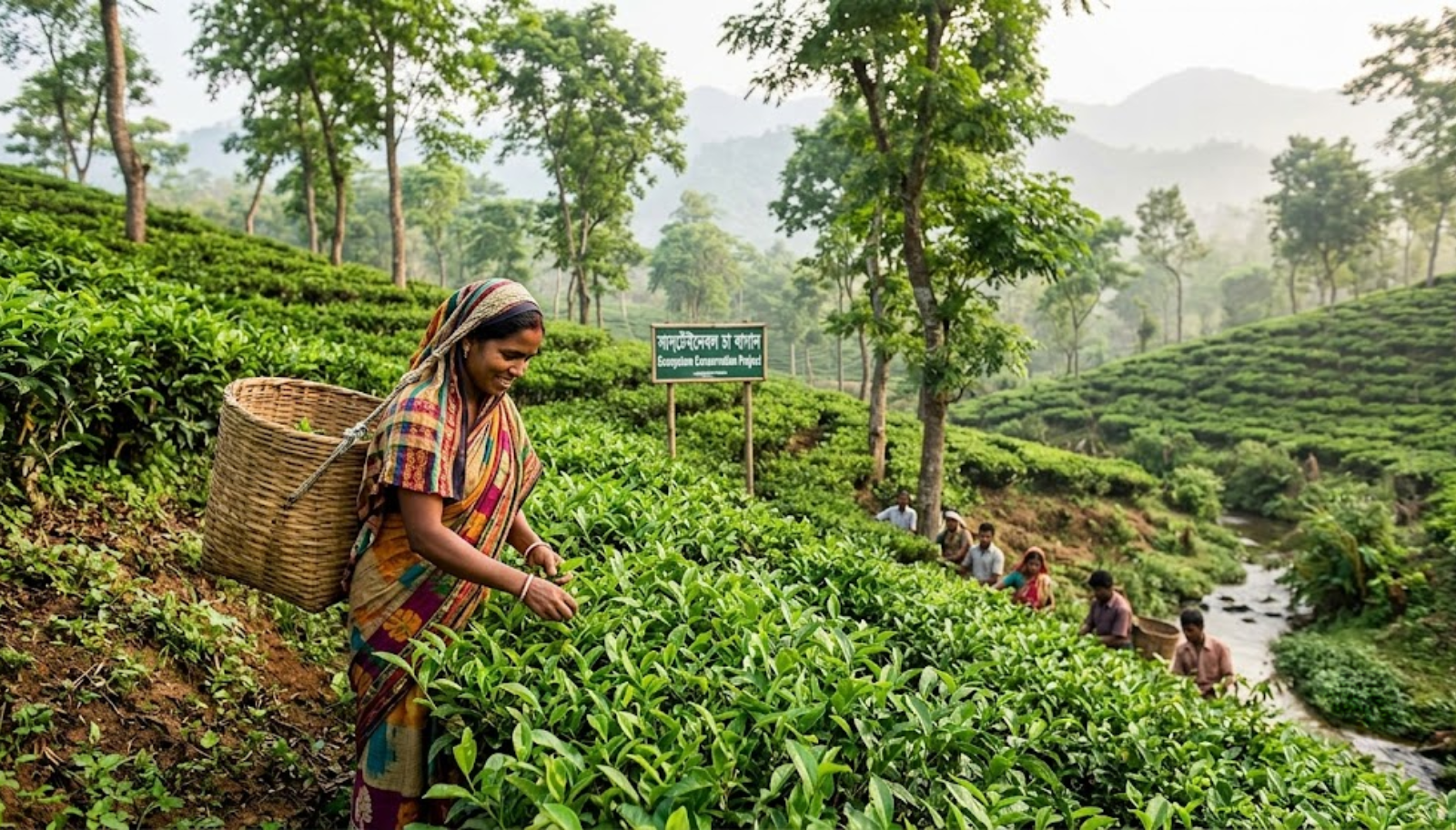
Bangladesh is the ninth largest tea producer in the world, with 168 tea estates spanning approximately 280,000 acres across Sylhet, Moulvibazar, Habiganj, Chittagong, and Panchagarh. The industry produces over 100 million kilograms of tea annually, directly employs around 150,000 workers, and supports roughly 4 million dependents. Tea contributes 1% to national GDP and has been a source of foreign exchange for nearly two centuries. Yet the sustainability of this heritage industry is now threatened by a convergence of environmental degradation, social injustice, and economic erosion that demands urgent attention.
Environmental Sustainability Under Threat
Tea in Bangladesh thrives in misty, moderate climates with reliable rainfall. Climate change is dismantling these conditions with alarming speed. In early 2025, Sylhet received only 4 millimetres of rain between January and March, compared with 46 millimetres in the same period the previous year, while March temperatures soared to 38 to 40 degrees Celsius. The Bangladesh Tea Board reported that January 2025 output plummeted by 57% compared with monthly averages. One Sylhet Garden saw its daily harvest fall from 4,500 kilograms to 2,500 kilograms, a 45% reduction caused directly by heat and drought.
Rising temperatures also fuel outbreaks of red spider mites, blight, and fungal diseases that further diminish yields. Scientific projections indicate that climate change could shrink tea yields by 5 to 25% in major growing regions by 2050. The environmental footprint of production compounds the problem: habitat conversion for plantation expansion reduces biodiversity, synthetic fertiliser runoff contaminates waterways, and traditional processing methods consume significant energy. Per hectare productivity in Bangladesh stands at just 1,245 kilograms, compared with 2,321 kilograms in Kenya and 1,763 kilograms in Sri Lanka, revealing both the degradation of aging tea bushes and the inadequacy of irrigation infrastructure that remains virtually unchanged from colonial times.
Social Sustainability in Crisis
The human cost behind every cup of Bangladeshi tea is the industry’s most critical sustainability failure. The tea garden workforce, predominantly women from marginalised ethnic communities, has laboured for five generations across 170 years under conditions that have been described as modern day slavery. Workers previously earned 120 taka per day, a sum that was raised to 170 taka only after massive protests in which they demanded 300 taka. At current exchange rates, this remains well below the living wage. Workers receive barely 3 kilograms of flour per week as ration, 46% of adolescents in tea garden communities are victims of child marriage, and 15% of women suffer from cervical cancer, with virtually no access to medical or educational facilities.
The casual alcoholism, indebtedness, and illiteracy that pervade these communities are not incidental misfortunes, but structural products of a wage system designed to keep a captive labour force subservient. The wage increases to 170 taka, while a step forward remains grossly insufficient for survival. Without resolving the social foundations of the industry, no environmental or economic reform can produce lasting sustainability.
Economic Sustainability at Stake
Bangladesh once exported 26,970 tonnes of tea annually; by 2016, exports had collapsed to just 77 tonnes as domestic consumption outpaced production. While exports rebounded to 2.45 million kilograms in 2024, the underlying economics remain precarious. Domestic auction prices range between 170 and 190 taka per kilogram, while production costs continue to rise with inflation, fertiliser price shocks, and the cost of adapting to climate disruption.
The gap between supply and demand means there is barely enough surplus for export, and global competition from Kenya, Sri Lanka, and India places downward pressure on prices. Aging bushes, ancient irrigation, and outdated processing technology keep productivity low, while the industry’s dominant business model prioritises volume over value addition, leaving Bangladesh trapped in a low-price commodity cycle.
The Path to Sustainable Tea
Climate adaptation must become the national priority for the Bangladesh Tea Board, with immediate investment in drip irrigation, rainwater harvesting, shade tree planting, and drought resistant tea varieties developed by the Bangladesh Tea Research Institute. In addition, the environmental footprint must be reduced through a mandatory transition to organic cultivation, composting instead of synthetic fertilisers, and interplanting with legume cover crops to restore soil health and biodiversity.
There is a need to revise the incentives package also. The daily wage for tea workers must be raised to at least 300 taka with comprehensive health insurance, educational scholarships for workers’ children, and housing upgrades as non-negotiable conditions of industry licence.
Aging tea bushes that have lost peak productivity must be systematically replaced through a nationally funded replanting programme. This must be supplemented by value addition through organic certification, specialty branding, tea tourism in Sylhet, and skincare product lines derived from tea extract must replace the raw commodity export model that keeps Bangladesh at the bottom of the global value chain. Flat land tea cultivation in Panchagarh and Thakurgaon, already contributing 12% of national output, must be expanded and supported with modern irrigation access.
The tea gardens of Bangladesh have sustained millions for nearly 200 years. Whether they sustain millions for the next 200 depends entirely on whether the industry chooses reform over extraction.