
Rudaina Bashir
Brunel University, UK
A recent Oniket Bulletin article, Zahir, F. (2026) “Beyond the Feast: Bangladesh’s Food Quality Crisis,“ made an important observation that deserves to be pushed further. It noted that the issue is not limited to roadside vendors, and that restaurant kitchens, including establishments that appear clean and professional from the dining area, may struggle with poor hygiene behind closed doors.
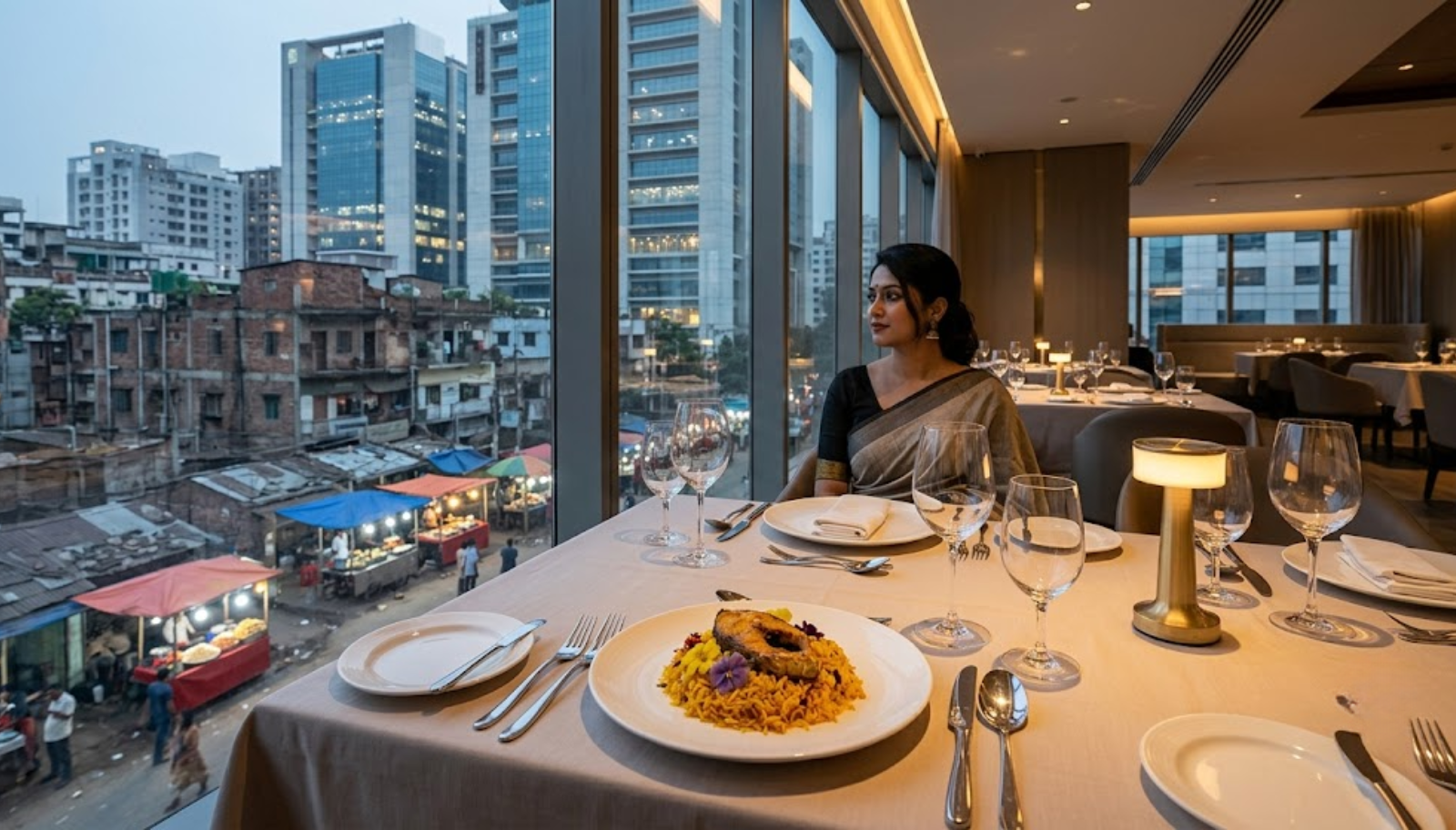
That warning applies with particular force to the high end a la carte and fine dining sector, a segment of Bangladesh’s food economy that has largely escaped the scrutiny applied to street food, precisely because its polished interiors and premium pricing create an illusion of safety that is rarely tested. This article is aimed at creating a platform to initiate the discussion.
The Assumption of Safety
Diners at an upscale restaurant in Gulshan, Banani, or Dhanmondi tend to assume that a high price tag guarantees clean sourcing, proper storage, and trained kitchen staff. That assumption is not grounded in any systematic inspection regime. Fine dining kitchens import specialty ingredients that may sit in storage for extended periods, operate elaborate a la carte menus that multiply the number of items requiring separate handling protocols, and often rely on open plan or rooftop layouts converted from spaces never designed to be commercial kitchens.
The same risks Zahir (2026) flagged for ordinary restaurants, cross contamination between raw and cooked ingredients, reuse of cooking oil beyond safe limits, and inadequate cleaning procedures, exist inside fine dining establishments as well, simply hidden behind better lighting and service.
When the Hazard Becomes Visible
Bangladesh has already seen what happens when these hidden risks combine with structural neglect. The fire at the Green Cozy Cottage building on Bailey Road in February 2024 killed forty-six people, many of them diners at restaurants operating inside a building that had been converted from residential or office use without adequate fire exits. It was not a roadside food stall that failed that night. It was a cluster of dining establishments, some marketed as premium venues, operating in a structure where safety compliance had never been meaningfully enforced.
In the weeks that followed, authorities discovered that similar arrangements were widespread. Rooftop restaurants such as those found in the Gawsia Twin Peak and Keari Crescent Tower buildings were sealed for fire safety violations or for operating without proper permits, and inspectors found upscale establishments housed in buildings approved for entirely different purposes.
Drives That Do Not Last
What followed the Bailey Road fire is itself instructive about the discontinuity problem in Bangladesh’s regulatory culture. In the immediate aftermath, Dhaka Metropolitan Police and city corporation mobile courts conducted hundreds of inspections within weeks, sealing buildings, fining establishments, and demolishing illegal structures. Yet enforcement of this intensity is rarely sustained.
Restaurant owners have publicly described the crackdown as a temporary wave that faded once media attention moved on, and the pattern is familiar from earlier episodes as well, where mobile courts fine a handful of restaurants for stale food, expired ingredients, or unhygienic storage, only for inspections to taper off until the next visible tragedy forces a fresh burst of activity.
A regulatory system built around reactive drives after a disaster, rather than a predictable and continuous inspection calendar, cannot protect diners at fine dining establishments who have no way of knowing when the last meaningful inspection took place.
Reforms Local Governance Must Make
Fixing this requires legal and institutional reform rather than another temporary drive. First, jurisdiction over restaurant safety is currently scattered across the Bangladesh Safe Food Authority, city corporations, Rajdhani Unnayan Kartripakkha, the fire service, and the police, and this fragmentation should be consolidated under a single accountable local authority for each ward, with clear statutory responsibility for both fire and food safety sign off before any restaurant license is issued or renewed.
Second, license renewal should be legally tied to a documented, dated inspection rather than a one-time approval, so that fine dining establishments cannot operate for years without a fresh review. Third, a public hygiene and safety rating, displayed visibly at the entrance and published online, should apply to every licensed restaurant regardless of price point, removing the assumption that expensive dining is automatically safe. Fourth, buildings converted from residential or office use into restaurant space should require a specific structural and fire safety certification, closing the loophole that made Bailey Road possible.
Finally, inspection schedules should be published in advance on a rolling basis, with results logged in a public digital registry, so that oversight becomes a permanent feature of local governance rather than a reaction to the last disaster. Bangladesh’s fine dining sector can only earn the trust its prices imply once its safety standards are enforced with the same consistency, whether or not a tragedy is required to prompt it.
Reference: